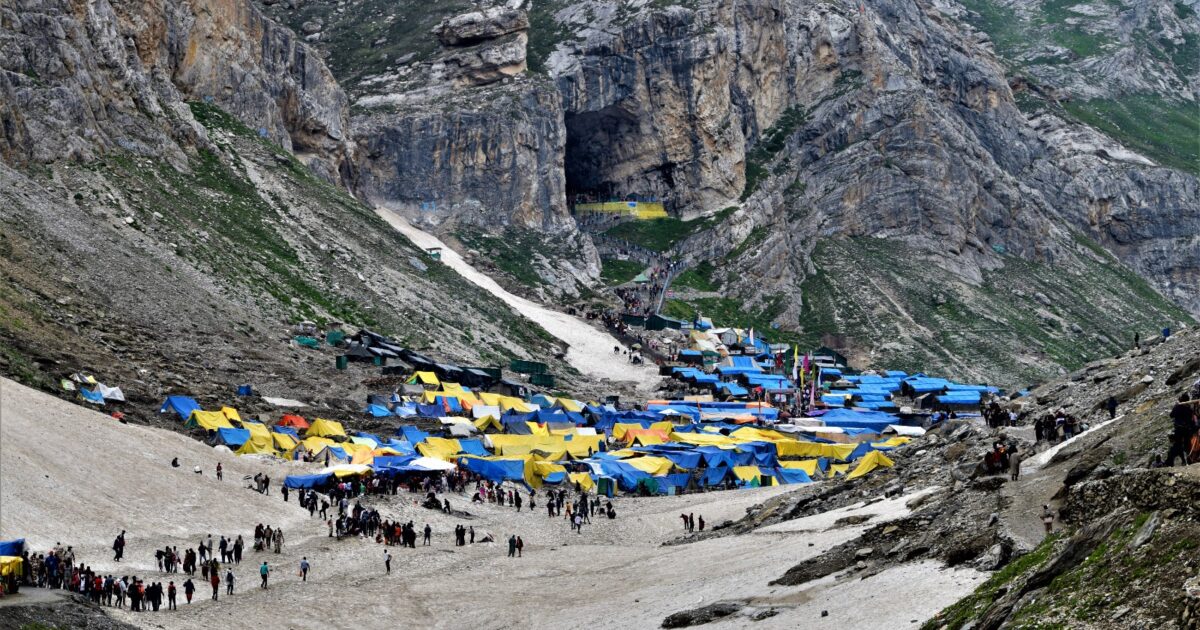
What is the Shri Amarnathji Yatra 2026 and when is it?
The annual Shri Amarnathji Yatra (pilgrimage) 2026 is scheduled to take place in Jammu and Kashmir from 03 July to 28 August, spanning 57 days. The pilgrimage culminates at the holy Amarnath Cave, situated at an altitude of approximately 3,888 metres (12,756 feet) in the Himalayas of Anantnag district, Jammu and Kashmir.
Which routes are used for the pilgrimage?
There are two officially designated routes for the pilgrimage to the Holy Cave. The Pahalgam–Holy Cave route is the traditional pilgrimage route, covering approximately 48 kilometres (one way) from Chandanwari. The Baltal–Holy Cave route is the shorter pilgrimage route, covering approximately 14 kilometres (one way) from Baltal Base Camp.
What traffic restrictions are in place?
The Jammu and Kashmir (J&K) Police has issued traffic regulations under which vehicles travelling from Kashmir towards Jammu will not be permitted to cross the Navyug Tunnel before 1130 hours (local time), while those travelling from Jammu towards Kashmir will not be permitted to cross the tunnel after 1500 hours (local time). Movement after 1800 hours (local time) will remain restricted following the withdrawal of Road Opening Parties (ROPs). Vehicles travelling from Pahalgam, Sonamarg and Gulmarg towards Srinagar or Jammu will not be permitted to proceed further and may be held at the nearest designated camp. The administration has also prescribed cut-off timings at multiple checkpoints along NH-44 and the pilgrimage corridors, including Nagrota, Jakheni, Navyug Tunnel, Mir Bazar, Panthachowk, Shadipora and Manigam. Travel disruptions are expected along the Jammu-Srinagar National Highway (NH-44), particularly on the Jammu-Udhampur-Ramban-Banihal axis, due to Yatra convoy movement, security checks, traffic regulations and rain-induced landslides. Expected rainfall and thundershowers during the opening week of the Yatra may slow trekking along the Chandanwari-Pissu Top-Sheshnag-Mahagunas Pass stretch of the Pahalgam route. Runway maintenance at Srinagar Airport every Monday and Tuesday from 01 July to 30 September is expected to limit flight availability and increase Yatra-related travel pressure on Jammu Airport and the Jammu-Srinagar NH-44 corridor.
What security measures have been deployed?
The Union Ministry of Home Affairs (MHA) has deployed more than 670 companies of the Central Armed Police Forces (CAPFs), marking the largest paramilitary deployment in the history of the pilgrimage. The deployment includes personnel from the Central Reserve Police Force (CRPF), Border Security Force (BSF), Indo-Tibetan Border Police (ITBP), Sashastra Seema Bal (SSB) and Central Industrial Security Force (CISF), alongside the Jammu and Kashmir (J&K) Police and the Indian Army. The Indian Army has launched Operation Shiva 2026 to strengthen Yatra security through enhanced surveillance, Quick Reaction Teams (QRTs), Bomb Detection and Disposal Squads (BDDS) and joint mock drills. The administration has introduced the PEHCHAAN QR-based identification system for pilgrim verification and movement management. The J&K Police in Anantnag has implemented Project Hawk Eye, integrating aerial surveillance, facial recognition technology, sniper deployment and an extensive CCTV network along the Pahalgam route. The Pahalgam and Baltal Yatra axes will remain No-Flying Zones from 01 July until the conclusion of the Yatra. Helicopter services for pilgrims will also remain suspended throughout the pilgrimage period.
What should organisations and individuals do to prepare?
It is advised to plan for possible delays and operational disruptions, as heightened security checks and traffic restrictions are likely to impact staff movement, business access, deliveries and supply chains. Commence travel well before the notified cut-off timings to accommodate delays caused by convoy movement, security checks and adverse weather. Keep Radio Frequency Identification (RFID) cards, registration slips, ID proof, medical certificates and travel permits easily accessible, as repeated checks are likely at entry points, camps and convoy-control locations. Follow J&K Traffic Police on X and the Shri Amarnathji Shrine Board website for the latest security, traffic and pilgrimage updates. Monitor the India Meteorological Department (IMD) Jammu and Kashmir for weather advisories throughout the pilgrimage period. Emergency numbers: Shri Amarnathji Shrine Board official helpline: 14464 / 1800-180-7198 / 1800-180-7199. Website: https://jksasb.nic.in/index.html. J&K Police emergency helpline: 112. Traffic Control Unit, Jammu: 0191-2451192 / 0191-2459048 / +91-9419147732 / 103. Traffic Control Unit, Srinagar: 0194-2455164 / 0194-2450022 / 0194-2485396 / 103.
Frequently asked questions
When is the Shri Amarnathji Yatra 2026?
The pilgrimage runs from 03 July to 28 August 2026, spanning 57 days.
What are the routes for the Shri Amarnathji Yatra 2026?
The two routes are the Pahalgam–Holy Cave route (48 km from Chandanwari) and the Baltal–Holy Cave route (14 km from Baltal Base Camp).
What are the emergency contact numbers for the Shri Amarnathji Yatra 2026?
Shri Amarnathji Shrine Board: 14464 / 1800-180-7198 / 1800-180-7199. J&K Police: 112. Traffic Control Unit Jammu: 0191-2451192. Traffic Control Unit Srinagar: 0194-2455164.
Download the full advisory now
datasurfr’s Risk Flash on the Shri Amarnathji Yatra 2026 carries the complete route details, traffic restrictions, security measures, and a detailed contacts directory. Download the full advisory now to brief your travel and continuity teams.
Filed under: India-South AsiaRegional Risk Reviews