KEY TAKEAWAYS:
- MitKat’s assessment of 17 November 2026 says Myanmar’s civil war, nearly six years after the February 2021 coup, remains intense and is increasingly regional in its effects. It cites UN estimates of close to 4 million internally displaced people and 16.2 million in need of humanitarian aid.
- The military is relying more on air power while its ground offensives in Rakhine, Kachin and Sagaing have stalled, and conflict monitors reportedly counted 347 military airstrikes in October 2026, killing 145 civilians.
- Spillover is visible but localised: stray fire and trade curbs on the Thai border, the Arakan Army (AA) reportedly holding the whole Bangladesh border, nearly 30,000 refugees in India’s Mizoram, and an AA siege of China’s Kyaukphyu port and pipeline hub.
- MitKat rates regional spillover at Level 2 (localised spillover) on a five-level scale, with property damage and one reported injury on foreign soil and no deaths. Continued localised spillover is the most likely path over the next three to six months, and the Sittwe front and the Momeik sector are the likeliest sources of escalation.
- The week of 15–19 November includes ASEAN’s agreement on a “calibrated engagement” with Naypyitaw and the International Court of Justice (ICJ) judgment on the Rohingya genocide case, due on 19 November.
- For business, the report points to intermittent border closures, tighter checks, fuel and power shortages inside Myanmar, project delays and sanctions and compliance questions. All figures are reported claims.
This summary draws on MitKat’s assessment and attributes its figures, ratings and probabilities to it. The conflict is ongoing and its facts are contested, and the report notes that many figures are reported by monitors or the parties themselves, so treat them as reported claims. The ICJ ruling referred to below was still upcoming when the report was written.
What is happening in Myanmar’s civil war in November 2026?
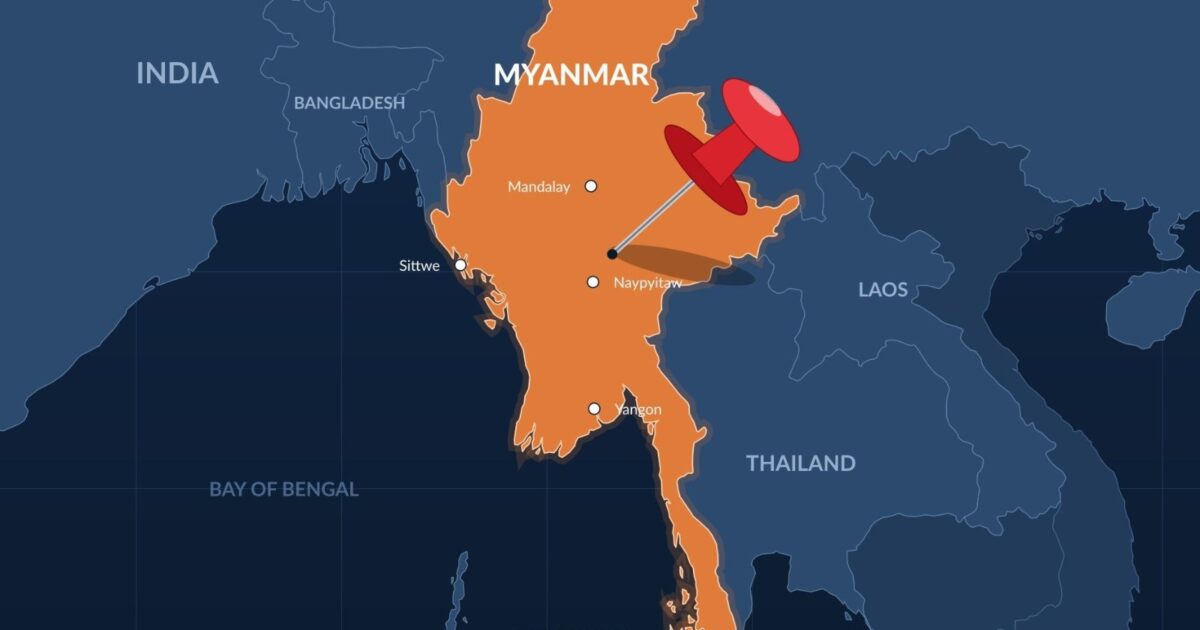
According to the report, the war has become a multi-front conflict between the military and a patchwork of ethnic armed organisations and People’s Defence Forces aligned with the National Unity Government. The military, now under a nominally civilian government led by President Min Aung Hlaing after elections widely dismissed as illegitimate, has stepped up air power, reportedly including newly acquired Russian Su-30 jets, while ground offensives against the AA near Sittwe and the Kachin-led alliance around Mawlu and Momeik have made little progress. Conflict monitors reportedly counted 347 military airstrikes in October, and strikes on schools, hospitals and displacement camps continued into November. On 15–16 November the military reportedly flew at least 12 bombing runs around Sittwe and renewed heavy attacks near Momeik. Major cities such as Yangon and Mandalay remain under military control but face fuel rationing, power cuts and conscription raids.
How did the conflict reach this point?
The report traces the main episodes below.
| Period | What the report records |
| Feb 2021 to 2022 | The military seizes power on 01 February 2021; peaceful protests are met with lethal force, and many protesters join People’s Defence Forces (PDFs) or ethnic armed organisations (EAOs) |
| Oct 2023 to 2024 | Operation 1027 in northern Shan triggers military defeats; by December 2024 the AA reportedly holds every military post along the Bangladesh border |
| Dec 2025 to Apr 2026 | Phased elections from 28 December 2025 exclude major opposition parties; Min Aung Hlaing is sworn in as president in April 2026 and hands command of the armed forces to Ye Win Oo |
| Jun 2026 | After Min Aung Hlaing’s visit to China, both sides agree to accelerate the Kyaukphyu port and the Muse–Mandalay railway; the AA siege has since stalled the port project |
| Sep to Oct 2026 | Military columns attempting to retake ground reportedly suffer heavy losses; the AA says it sank two military warships on 26 October; the military decides to escalate airstrikes in November |
| 25 Oct to Nov 2026 | Strikes hit Karen-held border crossings and a camp opposite Mae Sam Laep, Thailand; shells land on Thai soil; Thailand restricts informal trade and deploys F-16s |
| 15–19 Nov 2026 | ASEAN leaders endorse “calibrated engagement” on 15 November; the ICJ delivers its Rohingya genocide judgment on 19 November |
Who are the main actors?
The report lists the military and government (President Min Aung Hlaing and commander-in-chief Ye Win Oo), which controls the central heartland and major cities. The Arakan Army controls 14 of Rakhine’s 17 townships and the whole Bangladesh border, and on 13 November vowed to take the last three: Sittwe, Kyaukphyu and Manaung. The Kachin Independence Army and its allies are encircling Mawlu and Momeik and blocking the Mandalay–Myitkyina highway. The Karen National Union and its armed wing control large areas along the Thai border, and northern Shan groups (MNDAA, TNLA and UWSA) hold their areas under Chinese-brokered ceasefires. Rohingya armed groups, ARSA and the RSO, operate along the Bangladesh border and have stepped up clashes with the AA.
How is the conflict spilling over into neighbouring countries?
Thailand is the most exposed neighbour, according to the report. A Mae Sot resident was reportedly injured by stray ammunition on 29 October, Thai authorities suspended trade through unofficial crossings from 30 October to 05 November while official crossings stayed open, and Thai F-16s patrolled Mae Sot on 01 November and turned back a military aircraft near Phop Phra on 08 November. Bangkok has lodged formal protests and is preparing evacuation plans for vulnerable border communities.
In Bangladesh, the AA has reportedly controlled Myanmar’s entire border since December 2024. Dhaka confirmed on 08 November that it is holding talks with both the AA and the military government on repatriating Rohingya refugees, and Rohingya armed groups have stepped up attacks on AA positions as fighting nears Sittwe. The AA accuses some Border Guard Bangladesh personnel of supplying them, which the BGB denies. In India, Mizoram was sheltering 29,575 people from Myanmar as of August 2026, and New Delhi is fencing the entire 1,643-km border. China’s exposure is economic: Kyaukphyu, where the oil and gas pipelines terminate, is under AA siege, and the military destroyed four bridges leading to the town on 14 November.
Where are the hotspots?
| Location | Significance in the report | Risk |
| Sittwe (Rakhine) | The military’s last stronghold in northern Rakhine (about 7,000 troops); AA attacks on the Shwemingan naval base; 12+ air sorties on 15 November | High |
| Kyaukphyu (Rakhine) | Chinese port and pipeline terminus under AA siege; bridges destroyed on 14 November | High |
| Mrauk-U, Ponnagyun, Kyauktaw (Rakhine) | Repeated airstrikes on schools, hospitals, bridges and camps | High |
| Mawlu and Momeik (Kachin, Sagaing, Shan) | KIA-led encirclement; Mandalay–Myitkyina highway blocked; fighting resumed near Momeik on 16 November | High |
| Kyaikto and Doo Tha Htoo (Mon–Karen) | 1,200-strong military column and Karen counter-attacks | High |
| Sagaing and Magway regions | Highest airstrike counts; PDF and AA fighting; oilfield clashes | Medium |
| Mae Sot and Phop Phra (Tak, Thailand) | Stray fire, informal trade curbs, F-16 patrols | Medium |
| Mae Sam Laep (Mae Hong Son, Thailand) | Blast and shrapnel damage from a strike across the Salween River | Medium |
| Teknaf and Cox’s Bazar (Bangladesh) | Rohingya camps; ARSA and RSO activity; repatriation politics | Medium |
| Champhai and Zokhawthar (Mizoram, India) | Main refugee entry point from Chin State | Medium |
| Bandarban (Bangladesh), Moreh and Kamjong (Manipur), Ruili and Nansan (Yunnan) | Landmine incidents; border security amid Manipur’s own conflict; selective reopening of China’s trade gates | Low |
What is the outlook for the next six months and beyond?
The report expects fighting to continue at high intensity, with the military’s planned escalation of airstrikes keeping civilian casualties high. Spillover is expected to stay localised and episodic, concentrated on the Thai border opposite Tak and Mae Hong Son and on the Bangladesh border. The ICJ judgment on 19 November and the military government’s response may cause diplomatic friction but are unlikely to change the battlefield in the short term. It also expects Singapore, which takes the ASEAN chair in January 2027, to resist faster normalisation.
| Next 3–6 months | Probability | Expected developments | Business impact |
| Continued localised spillover (baseline) | Most likely | Periodic stray fire and airspace incidents near Mae Sot and the Salween; steady refugee flows to Mizoram and Bangladesh | Intermittent border trade disruption; heightened checks at crossings |
| Border de-escalation | Likely | The military relies on drones rather than jets near Thailand; Thai diplomatic protests reduce incidents | Smoother cross-border logistics through official crossings |
| Wider cross-border incidents | Less likely | Strikes causing casualties on Thai or Bangladeshi soil; prolonged closure of official crossings | Supply chain delays; temporary suspension of border operations |
| Next 1–2 years | Probability | Expected developments | Business impact |
| Protracted war, managed spillover (baseline) | Most likely | Front lines shift slowly; neighbours manage border incidents through protests and patrols | Ongoing need for border contingency planning |
| Negotiated ceasefires or talks | Less likely | ASEAN, China or US-backed talks produce local ceasefires | Gradual recovery of trade corridors and investment projects |
| Regional destabilisation | Less likely | Fall of Sittwe or Kyaukphyu, large refugee surges, or serious clashes with a neighbour’s forces | Major disruption to regional logistics and projects |
MitKat assesses regional spillover at Level 2 (localised spillover) on a five-level scale. Moving to Level 3 would need a clear change in pattern, such as fatal strikes on a neighbour’s territory, the closure of official crossings for weeks, or a sudden large refugee influx. Its watch indicators include casualties on Thai soil, prolonged closure of the Mae Sot, Tamu–Moreh or Ruili gates, the fall of Sittwe or Kyaukphyu, sudden refugee spikes of several thousand, confirmed incursions into neighbouring airspace, and a breakdown in relations with a neighbour.
What does the conflict mean for businesses?
On trade, the report expects short suspensions of informal crossings and enhanced checks, with Mae Sot–Myawaddy the key overland route, and notes that warnings against trade with Karen-controlled routes create legal and reputational uncertainty. Inside Myanmar, fuel shortages, price inflation, power cuts and conscription raids affect staff availability and costs in Yangon and Mandalay, and travel outside major cities is hazardous because of airstrikes, landmines and checkpoints. Investment projects, including the Kyaukphyu special economic zone and port, the Kaladan corridor and Muse–Mandalay rail, face delays tied to fighting around project sites, and Bay of Bengal shipping and port access in Rakhine are affected. Engagement with both the government and armed-group administrations raises sanctions, licensing and due-diligence questions. Border communities face stray-fire risks, and militia-linked scam compounds near Thailand raise crime and kidnapping risks.
What should organisations and individuals do?
For organisations, the report recommends mapping exposure of staff, suppliers and logistics routes to Myanmar’s border areas and Rakhine, tracking the status of official crossings (Mae Sot–Myawaddy, Tamu–Moreh, Ruili–Muse) and Thai trade restrictions daily, reviewing sanctions and compliance positions on dealings with both government and EAO-controlled areas, and building inventory buffers. During operations, it advises avoiding non-essential travel to border strips opposite active fighting, using only official crossings and verified transport providers, maintaining check-in procedures for staff in Tak, Mae Hong Son, Cox’s Bazar, Mizoram and Manipur, and monitoring ICJ, ASEAN and neighbouring government statements. On escalation, it advises applying pre-agreed triggers to suspend border operations or relocate staff, activating alternative routes such as sea freight via Yangon or air if land crossings close, coordinating with embassies on evacuation plans, and communicating early with clients and partners. For individuals, it advises avoiding travel to conflict-affected states and regions and following government travel advisories, staying away from the river border and knowing the nearest shelter in Thai border districts, not using informal crossings, being alert to job offers linked to scam compounds, avoiding camp areas and the border strip in Cox’s Bazar and Bandarban unless travel is essential and authorised, and verifying information through official sources.
Frequently asked questions
How serious is the spillover into neighbouring countries?
MitKat rates it Level 2 of 5, localised. Incidents on foreign soil have caused property damage and one reported injury, not deaths, and official crossings with Thailand, India, Bangladesh and China remain open or have reopened.
What is the ICJ ruling on 19 November about?
The ICJ is due to deliver its final judgment, which cannot be appealed, in the case brought by The Gambia against Myanmar under the Genocide Convention concerning the Rohingya. The report expects it to cause diplomatic friction but not to change the battlefield in the short term. Check the outcome, because this post was written before the ruling.
What did ASEAN decide on 15 November?
ASEAN leaders endorsed a Thai-proposed “calibrated engagement” with Naypyitaw that ties any restoration of Myanmar’s political representation to progress on the ground. The bloc kept its bar on Myanmar’s leadership attending summits and foreign ministers’ meetings, while saying Myanmar’s participation in sectoral bodies should be unrestricted.
Which official sources should I monitor?
The report lists the Ministry of Foreign Affairs of Thailand (mfa.go.th), the Mae Sot Customs House (customs.go.th), India’s Ministry of External Affairs (mea.gov.in), Bangladesh’s Ministry of Foreign Affairs (mofa.gov.bd), the ASEAN Secretariat (asean.org), the ICJ (icj-cij.org), UNHCR (data.unhcr.org) and the US Department of State travel advisories (travel.state.gov).
Download the full assessment now
MitKat’s Assessment, Myanmar Conflict: Security Outlook (as of Nov 2026), carries the full actor analysis, the hotspot maps, the Rakhine township control map, the scenario probabilities, the spillover escalation ladder with recommended business postures, and the detailed impact assessment and recommendations. Download the full assessment now to brief your security and operations teams.
Filed under: APACRegional Risk Reviews