What is the Mecca Joint Defence Agreement?
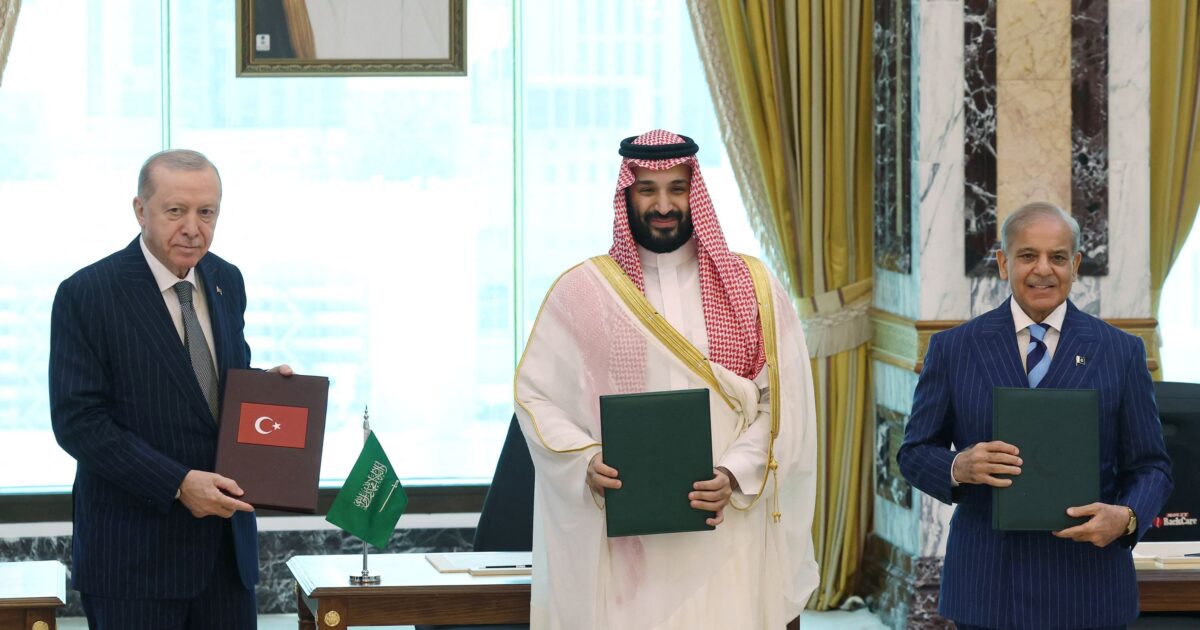
The Mecca Joint Defence Agreement is a collective defence pact signed on 07 August 2026 in Mecca by Saudi Arabia, Türkiye and Pakistan. The central provision treats an armed attack against one signatory as an attack against all three. It builds on the Saudi Arabia–Pakistan Strategic Mutual Defence Agreement of 17 September 2025, adding Türkiye to the framework. Saudi Arabia is the principal Gulf member, Pakistan provides a South Asian military link and nuclear-armed deterrent capability, and Türkiye provides a NATO-linked military and defence-industrial capability. The agreement creates a mechanism for enhanced political and military coordination involving defence and foreign ministers as well as military commanders. A ministerial committee and a secretariat based in Saudi Arabia are planned, with operational details expected to be developed through subsequent meetings.
When and where was it signed?
The agreement was signed on 07 August 2026 in Mecca. It was signed while the US–Iran conflict remained active and regional shipping through the Strait of Hormuz was disrupted. Saudi Arabia has faced direct and proxy-linked threats to infrastructure and shipping. The timing is significant because it expands Riyadh’s security partnerships beyond reliance on a single external provider and creates a regional mechanism with greater emphasis on Saudi-led coordination.
Which countries are members and what are their capabilities?
The three signatories are Saudi Arabia, Türkiye and Pakistan. Together they form a sizable military bloc, combining nearly 1.4 million active military personnel, 3,400 aircraft, 6,000 tanks and more than 340 naval assets. Saudi Arabia brings financial resources and regional influence, Türkiye contributes an expanding defence industry and NATO membership, and Pakistan brings significant military experience and nuclear deterrence. The agreement is described as defensive and open to additional countries committed to peaceful conflict resolution and strategic cooperation. Egypt has been identified publicly as a possible future participant, but membership expansion remains prospective.
What are the key provisions?
The collective defence provision treats an armed attack against one signatory as an attack against all three. Defence and military coordination will involve stronger coordination among foreign and defence ministries and military leadership. Joint training and operational cooperation covers land, maritime, air and cyber domains, with joint exercises expected to include unmanned systems, electronic warfare and artificial intelligence applications. Defence-industry cooperation promotes joint development, production and technology transfer. Pakistani Foreign Minister Ishaq Dar described the arrangement as purely defensive. Turkish authorities stated the framework complements existing alliances and is not intended to replace Türkiye’s NATO commitments.
How does it compare to NATO?
Both frameworks use language under which an armed attack against one member is treated as an attack against all members. NATO Article 5, however, requires each Ally to take the action it deems necessary and does not automatically prescribe military force. Membership scale: the Mecca framework currently has three members; NATO has 32. Institutional depth: NATO operates through permanent political institutions, military commands, national delegations, committees and standing structures. The Mecca framework is still establishing its ministerial committee and Saudi-based secretariat. Operational integration: NATO has decades of common exercises, doctrine, force planning, command structures and interoperability standards. The Mecca framework has announced joint exercises and technical cooperation, but the scale of integration remains under development. Nuclear posture: Pakistan is a nuclear-armed state, but the Mecca pact does not publicly establish a nuclear-sharing or integrated nuclear planning arrangement comparable with NATO mechanisms. Alliance overlap: Türkiye’s simultaneous NATO membership makes the Mecca framework an additional partnership rather than a substitute.
What are the implications for the Middle East and India–Pakistan?
The pact increases the political cost of attacks on Saudi territory, energy infrastructure, military facilities or maritime interests. The immediate deterrent effect is stronger than the operational effect because command, force-generation and crisis-response arrangements are still developing. Iran may assess the pact as an additional layer of regional military coordination. The agreement could reduce Saudi reliance on ad hoc external responses during US–Iran escalation. For India–Pakistan, the pact adds a new dimension to strategic competition by giving Pakistan a formal security framework with Saudi Arabia and Türkiye. Although India is not explicitly identified as a threat, an armed attack on one signatory is to be treated as an attack on all three, potentially giving Islamabad additional diplomatic and security leverage during a future crisis. Direct Saudi or Turkish military intervention in an India–Pakistan conflict is unlikely to be automatic. The response would depend on the circumstances of a crisis and political consultations. India is likely to closely monitor these developments. The Ministry of External Affairs has stated that India is examining the agreement from the perspective of national security and regional peace and stability.
What are the business impacts and what should organisations do?
Businesses should monitor developments along key shipping lanes and maritime chokepoints, particularly the Strait of Hormuz, Gulf of Oman, Arabian Sea, Red Sea and Bab el-Mandeb, and assess potential impacts on shipping schedules, freight costs, insurance premiums and supply-chain continuity. Regularly review geopolitical risk assessments and business continuity plans. Identify critical suppliers, logistics routes, ports and other operational dependencies, and maintain alternative arrangements where feasible. Review employee travel and security protocols. MNCs in defence, aerospace, cybersecurity, AI, drones and sensitive technology sectors should monitor procurement, investment and joint-production opportunities. MNCs involved in defence or dual-use technologies should ensure compliance with applicable sanctions, export controls, licensing requirements and regulatory restrictions. Monitor changes in government policies, defence procurement priorities and regulatory requirements. Maintain regular communication with local security teams. Establish clear escalation triggers for reassessing risk posture, including activation of the collective-defence provision, significant military deployments, deterioration in bilateral relations, new sanctions or major changes in defence cooperation.
Frequently asked questions
When was the Mecca Joint Defence Agreement signed?
It was signed on 07 August 2026 in Mecca by Saudi Arabia, Türkiye and Pakistan.
Which countries are members?
Saudi Arabia, Türkiye and Pakistan. Egypt has been identified as a possible future participant.
Does the pact replace NATO or other alliances?
No. The signatories state it is defensive, does not target any specific country, and does not replace existing bilateral or multilateral alliances. Türkiye remains a NATO member.
What are the business risks?
Increased security costs, transport disruptions, energy-price volatility, higher insurance premiums, airspace restrictions and supply chain delays affecting Gulf and Red Sea-linked routes.
Download the full advisory now
MitKat’s Special Report on the Mecca Joint Defence Agreement carries the complete provisions, comparative assessment with NATO, regional implications and recommendations. Download the full advisory now to brief your strategy and continuity teams.
Filed under: EMEAThreat Intelligence Special Reports