KEY TAKEAWAYS:
- August 2026 brings large public events, labour action, elections and banking-continuity risk across EMEA. Amsterdam’s WorldPride Canal Parade on 01 August closes the central canal ring for the day, Zurich’s Street Parade on 08 August is expected to draw 800,000 to 1,000,000 people, and Glasgow hosts the World Pipe Band Championships from 13 to 15 August.
- East Midlands Railway strikes include 24-hour stoppages on 01, 08 and 15 August, and Botswana’s truck drivers plan protests and go-slow action on 05 August along key SADC freight corridors.
- Zambia holds general elections on 13 August and Nigeria’s Osun State votes for a governor on 15 August.
- Five Palestinian banks reliant on Bank Hapoalim were told correspondent banking services could end from 13 August, with others possibly from 01 September. The UAE is expected to observe a Prophet Muhammad’s Birthday holiday around 25 August, subject to moon-sighting.
- Geopolitically, the report identifies the US-Iran confrontation, including a US naval blockade and near-standstill shipping in the Strait of Hormuz, and the Russia-Ukraine war as the main risks to energy, aviation and supply chains.
August 2026 is a complex month for EMEA, mixing mass events and public holidays in Europe with elections, industrial action and financial-continuity risk in the Middle East and Africa, all against an unresolved geopolitical backdrop. Businesses should expect localised transport and access disruption and keep contingency plans ready for supply-chain and payment delays.
Which large events could disrupt business in Europe in August?
Amsterdam’s WorldPride Canal Parade on 01 August, the flagship event of WorldPride Amsterdam 2026, features around 80 floats and is expected to draw hundreds of thousands of spectators; canal navigation restrictions, quayside vehicle bans and road closures across the central canal ring run from 0000 to 2359 hours, with the main disruption between 1200 and 1800 hours, and last-mile deliveries and waste collection in the centre are likely to be affected. Zurich’s Street Parade on 08 August is expected to attract 800,000 to 1,000,000 people, with comprehensive road closures around Lake Zurich, diverted tram and bus lines, severe congestion at Zurich Hauptbahnhof, Stadelhofen and Enge stations, and security measures from early 08 August until late 09 August; businesses are advised to complete critical deliveries before 0600 hours on 08 August and consider remote work for non-essential staff. In Scotland, the World Pipe Band Championships bring road closures and parking restrictions around Glasgow Green from 13 to 15 August, following the Commonwealth Games that ended on 02 August. Public holidays include Swiss National Day (01 August), Ireland’s August Bank Holiday (03 August), Assumption Day (15 August), Hungary’s St Stephen’s Day (20 August) and the UK Summer Bank Holiday (31 August).
What labour action and demonstrations should businesses expect?
East Midlands Railway strike action runs throughout August, including 24-hour strikes on 01, 08 and 15 August plus continuous action short of strike, reducing services on the Midland Main Line and affecting rail links across the East Midlands and to London. In Botswana, truck drivers’ associations have announced nationwide protests and go-slow action on 05 August, raising the likelihood of delays along key Southern African Development Community freight corridors and border crossings such as Tlokweng/Kopfontein, Pioneer Gate and Ramatlabama, with prolonged customs delays anticipated. In Poland, a teachers’ union plans a demonstration outside the Prime Minister’s Office in Warsaw on 31 August, likely to cause temporary congestion and added security in the government district.
Which elections and banking changes carry risk in the Middle East and Africa?
Zambia holds general elections on 13 August, with President Hakainde Hichilema of the UPND seeking a second term against a field of 14 presidential candidates, the main challenge coming from Brian Mundubile of the opposition Tonse Alliance; a candidate needs more than 50 percent in the first round to avoid a run-off, and increased security deployments and short-notice disruptions are expected. Nigeria’s Osun State governorship election on 15 August involves 2,333,233 registered voters, with security tension expected to intensify through election day. Separately, five Palestinian banks that rely on Bank Hapoalim for correspondent banking have reportedly been told those services could cease from 13 August, and institutions using Israel Discount Bank have been advised similar arrangements may end from 01 September; the Palestinian Monetary Authority has warned this could disrupt trade and government operations, and the report notes about 90 percent of Palestinian trade depends on banking links through Israel. Negotiations to preserve the links continue, but short-term disruption to shekel payments, trade finance and salary transfers cannot be ruled out. In the UAE, a public holiday for Prophet Muhammad’s Birthday is expected around 25 August, subject to moon-sighting, which may produce an extended weekend and reduced public-sector processing.
What geopolitical risks are affecting supply chains and travel?
According to the report, the fragile US-Iran de-escalation unravelled in July: after an Iranian strike on a commercial container vessel on 11 July, US forces struck Iranian missile and naval sites, and a US naval blockade around Iranian ports was announced on 13 and 14 July. The report states that three US service members were killed in Iranian strikes on 18 and 19 July, that shipping through the Strait of Hormuz fell to a near-standstill, and that more than 6,000 seafarers were left stranded on hundreds of vessels. The report expects continued pressure on energy markets, maritime logistics and aviation through August. It also describes the Russia-Ukraine war, at 53 months as of 26 July, as continuing with reciprocal long-range missile and drone attacks, including a Ukrainian launch of more than 400 drones towards Moscow on 20 July, and adds that Israel and the West Bank remain under heightened security alerts. Other July developments still shaping the environment include the UK’s designation of the IRGC as a national security threat on 17 July, Sweden’s expanded VAT fraud enforcement, South Africa’s mandatory online traveller declaration, and the launch of the UAE’s electronic invoicing pilot.
What should businesses do to prepare?
Organisations should map deliveries, staff routes and customer access against the Amsterdam, Zurich and Glasgow closures, and complete time-critical logistics before each event. Companies relying on UK rail should plan alternative travel for the 01, 08 and 15 August strike days, and freight operators on SADC corridors should build in delay allowances around 05 August. Firms with Zambia or Nigeria operations should monitor election-related security developments, and anyone transacting with the West Bank should speak to their banks about alternative payment channels before 13 August. Businesses exposed to Gulf shipping, energy prices or Middle East aviation should keep supply-chain and routing contingencies active, and continue monitoring official security and travel advisories.
Frequently asked questions
How big is Zurich’s Street Parade and what closes?
It is expected to draw 800,000 to 1,000,000 attendees on 08 August, with road closures around the Lake Zurich basin including Seefeld, Bellevue, Quaibrücke, Bürkliplatz and Enge, diverted trams and buses, and parking restrictions in Districts 01, 02 and 08.
When are the East Midlands Railway strikes?
24-hour strikes are scheduled on 01, 08 and 15 August, alongside continuous action short of strike throughout August that reduces services on the Midland Main Line.
What is the risk to West Bank banking from 13 August?
Five Palestinian banks that use Bank Hapoalim for correspondent services were reportedly told those services could end from 13 August, which could delay cross-border shekel payments, trade finance and salary transfers; negotiations to preserve the links were ongoing, so the outcome was not settled at the time of the report.
Download the full report now
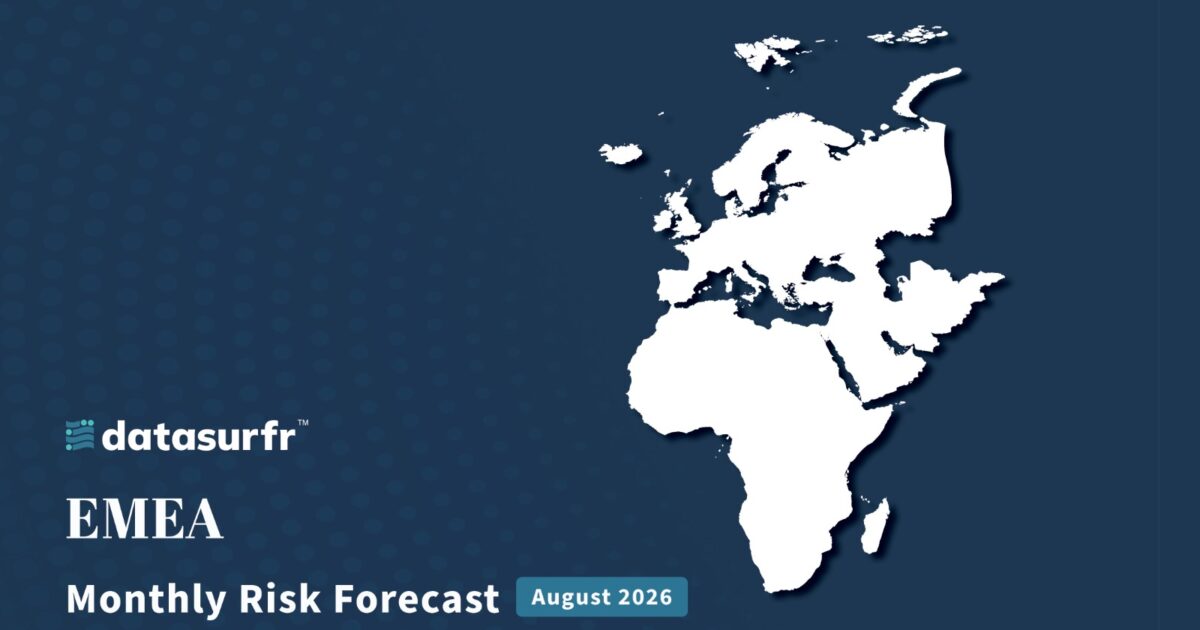
datasurfr’s EMEA Monthly Risk Forecast for August 2026 carries the complete country-by-country breakdown, an escalation snapshot covering the Russia-Ukraine war and the Middle East, and a full regional event calendar. Download the full report now to brief your risk and continuity teams.
Filed under: EMEARegional Risk Reviews