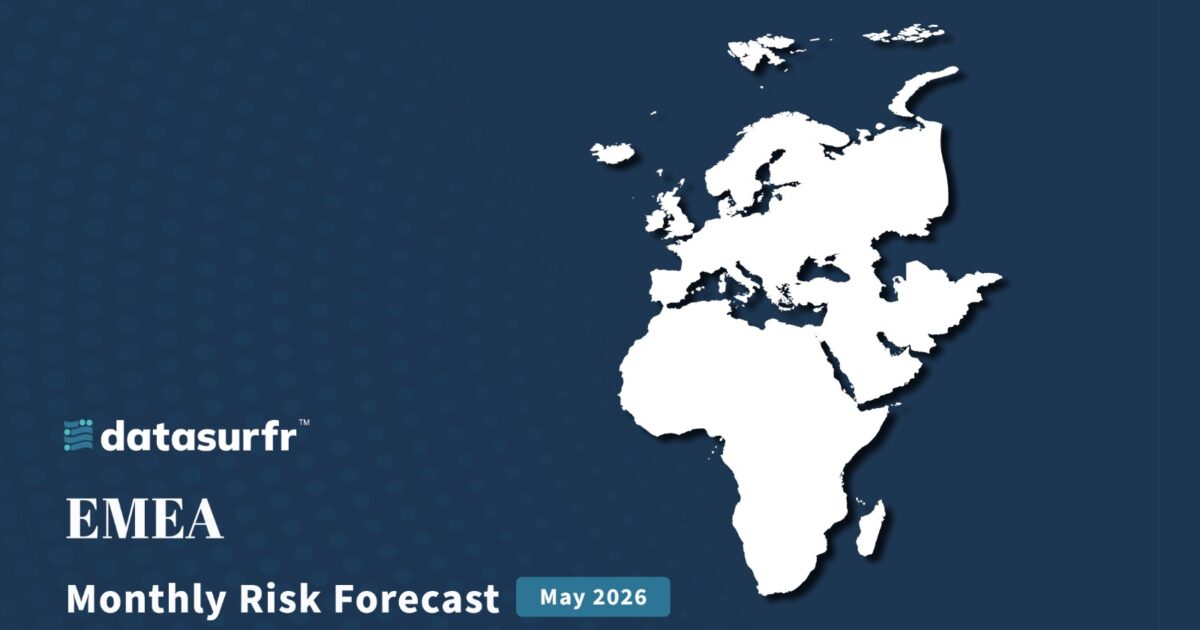
What is the EMEA Monthly Risk Forecast May 2026?
The EMEA Monthly Risk Forecast May 2026 provides a comprehensive assessment of operational and security risks across Europe, the Middle East and Africa. April 2026 left EMEA operating in a heightened risk environment shaped by political transitions, labour unrest, holiday-related mobility pressure, and persistent geopolitical instability. May 2026 is expected to remain operationally sensitive, with Europe facing a heavy calendar of public holidays, protests, elections, strikes, and weather-related pressure, while MENA continues to face elevated disruption risk from regional tensions, religious observances, and localized social unrest. The most consequential escalation remains the Middle East security shock, where the Israel-Iran confrontation and related ceasefires have not restored stable conditions, and the Russia-Ukraine war remains active at high intensity.
What are the key events and dates in May 2026?
Key dates include: 01 May — Labour Day/International Workers’ Day across EMEA; 04 May — May Bank Holiday in UK and Ireland; 05 May — Liberation Day in the Netherlands; 07 May — National parliamentary elections in Scotland and Wales, local council and mayoral polls in England, and Egypt’s Labour Day in lieu; 08 May — Victory in Europe Day in France and Czech Republic; 09 May — Europe Day across the EU and Victory Day in Russia, Belarus, Georgia and Moldova; 14 May — Ascension Day in Europe; 17 May — Constitution Day in Norway; 22 May — Shavuot in Israel; 25 May — Whit Monday across Europe and Spring Bank Holiday in the UK; 26 May — Arafat (Hajj) Day; 26–29 May — Hajj Pilgrimage in Saudi Arabia; 27–29 May — Eid al-Adha across the Middle East and Africa.
Which countries are most affected by strikes and disruptions?
Italy faces significant transport disruption throughout May, with a 48-hour nationwide strike led by the CSLE union commencing on 15 May, a potential five-day road freight strike from 25–29 May, and a nationwide railway strike from 21:00 on 28 May to 21:00 on 29 May. Ireland’s National Ambulance Service faces a phased programme of industrial action: work-to-rule from 11 May, a 24-hour nationwide strike on 12 May, a 48-hour stoppage from 19 May, and a 72-hour stoppage from 26 May. France faces continued construction and lorry driver protests over fuel prices, with a planned CGT Transport strike on 05–06 May targeting logistics networks and refinery operations. The UK holds national parliamentary elections in Scotland and Wales, plus local council and mayoral polls in England on 07 May. Cyprus holds parliamentary elections on 24 May. Uganda holds the presidential inauguration of President Yoweri Museveni on 12 May at Kololo Ceremonial Grounds in Kampala. Ghana hosts the African Inter-Parliamentary Conference in Accra from 27–30 May.
What is the impact of the heatwave outlook?
Reports indicate a pronounced trend toward above-normal land surface temperatures across the EMEA region through May 2026 and into summer. Southern and central Europe, along with Northern Africa, are expected to experience early-season heat stress, particularly across the Iberian Peninsula. Energy systems are likely to face early and sustained surges in cooling demand, increasing the risk of grid instability and electricity price spikes. Agriculture faces accelerated crop cycles, soil moisture depletion, and higher irrigation requirements. Manufacturing and logistics sectors may encounter productivity losses due to worker heat exposure and infrastructure strain. Insurance and finance sectors face elevated exposure to claims linked to droughts, wildfires, and heat-related damages. Businesses should enhance energy efficiency, invest in water conservation technologies, implement heat-resilient workplace policies, and adopt climate-informed scenario planning.
What is the impact of the Middle East security shock?
The conflict following the 28 February strikes has transformed the Middle East into a high-risk zone for global transit. Maritime transit through the Strait of Hormuz is down 95 percent, with only “non-hostile” vessels permitted. Aviation remains restricted, with major hubs like Dubai and Doha operating at reduced capacity (50–60 percent). 400+ tankers are stranded in the Persian Gulf, and there is a global oil shortfall of 14–15 mb/d due to production halts in Kuwait, UAE, and Iraq. Global oil prices exceed USD 100 per barrel. The Russia-Ukraine war remains active at high intensity, with repeated missile and drone strikes, infrastructure damage, and continued pressure on transport, energy, and logistics networks across Eastern Europe.
What should organisations and individuals do to prepare?
Organisations should confirm country-specific holiday schedules, plan around reduced operational capacity, avoid critical deadlines during holiday periods, and finalise time-sensitive regulatory or banking matters in advance. Diversify logistics partners, increase inventory buffers, reschedule non-essential shipments, and implement flexible working arrangements and staggered shifts. Monitor official platforms such as the Ministry of Infrastructure and Transport in Italy, and maintain real-time tracking of security advisories. For the heatwave, enhance energy efficiency, invest in water conservation, and implement heat-resilient workplace policies. For the Middle East, avoid non-essential travel to affected areas, monitor maritime and aviation advisories, and review force majeure and war-risk clauses in commercial contracts. Individuals should check reliable news platforms, use navigation apps for live traffic, avoid protest zones, and comply with law enforcement directions.
Frequently asked questions
What is the EMEA Monthly Risk Forecast May 2026?
The EMEA Monthly Risk Forecast May 2026 is a comprehensive assessment of operational and security risks across Europe, the Middle East and Africa, covering elections, strikes, protests, weather, and geopolitical instability.
When are the key elections in EMEA in May 2026?
National parliamentary elections in Scotland and Wales plus local council and mayoral polls in England on 07 May, and parliamentary elections in Cyprus on 24 May.
What are the emergency contact numbers for EMEA countries?
For EU-wide emergencies: 112. UK: 999. Ireland: 112 or 999. Italy: 112. Cyprus: 112 or 199. Uganda: 999 or 112. Ghana: 191 (Police), 192 (Fire), 193 (Ambulance). Saudi Arabia: 999 (Police), 997 (Ambulance), 998 (Fire).
Download the full advisory now
datasurfr’s Special Advisory on the EMEA Monthly Risk Forecast May 2026 carries the complete event calendar, the full country-by-country impact assessment, and a detailed contacts directory. Download the full advisory now to brief your travel and continuity teams.
Filed under: EMEARegional Risk Reviews