KEY TAKEAWAYS:
- Delhi’s Winter Pollution Master Plan applies from 01 November 2026 to 28 February 2027, running alongside the Commission for Air Quality Management’s Graded Response Action Plan (GRAP), whose Stage I was invoked across Delhi-NCR on 21 October after Delhi’s daily AQI rose from 179 to 245 (‘Poor’).
- Key business measures include a cap of 50 percent physical attendance at private offices in the NCT of Delhi from 01 November to 31 January, with staggered hours and reduced commute-related vehicle movement, plus doubled parking charges at authorised sites from 01 November to 28 February (DMRC-managed facilities exempt).
- Non-BS-VI vehicles registered outside Delhi are barred from entering from 01 November to 31 January, subject to exemptions, and a complete ban on construction and demolition applies from 10 December to 20 January.
- Commercial high-rises above 3,000 square metres must install anti-smog guns or mist systems, and a PUCC is required for refuelling all year. Essential and emergency services are exempt from the work-strength rules.
- Businesses should audit fleets, publish attendance policies and plan project schedules before 01 November.
Delhi’s winter air-quality rules take effect on 01 November, and several of them change how businesses staff offices, move vehicles and schedule construction. This summary draws on datasurfr’s special advisory and describes the rules as that advisory reports them. It also includes general health guidance from the advisory, which is not personalised medical advice. Check the current text of each order before relying on it, since stages and exemptions can change.
What are the Delhi winter pollution measures for 2026–27?
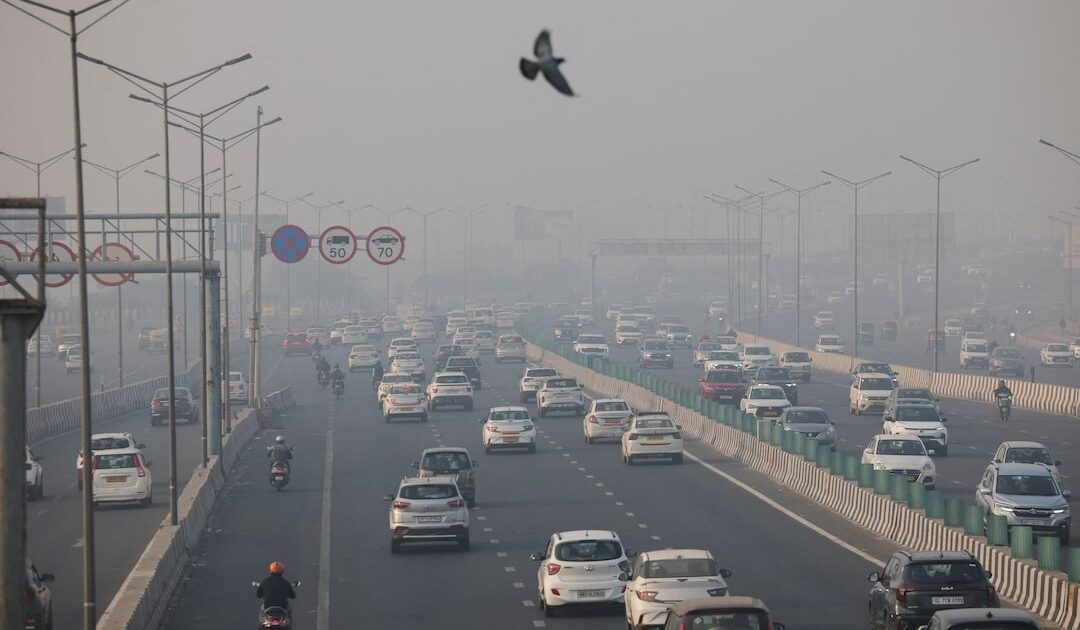
The Delhi government’s Winter Pollution Master Plan applies from 01 November 2026 to 28 February 2027 in the NCT of Delhi, alongside CAQM’s GRAP, under which extra restrictions switch on as air quality worsens. The advisory describes the master plan as a proactive seasonal framework with fixed dates, and GRAP as a reactive, AQI-triggered framework covering the whole of Delhi-NCR. Where the two overlap, the stricter GRAP measures prevail once invoked. Pollution typically starts building in September and October, with the hardest period generally from November to January, as cold, low winds and atmospheric inversion limit dispersion of vehicle, dust, industrial and stubble-burning emissions.
What is the current GRAP stage in Delhi-NCR?
CAQM invoked Stage I of GRAP across Delhi-NCR with immediate effect on 21 October, after Delhi’s daily AQI rose to 245, in the ‘Poor’ category, from 179 the day before. The advisory says the revised GRAP schedule was approved by CAQM in late September and contains 48 actions: 25 in Stage I, eight in Stage II, ten in Stage III and five in Stage IV. Under the schedule, staggered office timings and higher parking charges come in at Stage II, and construction restrictions intensify from Stage I through Stage IV. Separately, a standing CAQM direction bars commercial goods vehicles registered outside Delhi that are not BS-VI compliant from entering Delhi from 01 November, whatever the GRAP stage; BS-IV goods vehicles were allowed entry only until 31 October as a transitional measure, and Delhi-registered goods vehicles, BS-VI diesel vehicles and CNG, LNG or electric vehicles are not restricted.
What do the rules mean for offices, staff and commuting?
Every private office in the NCT of Delhi must operate with no more than 50 percent of staff physically present from 01 November to 31 January, with the rest working from home. Private entities must also stagger working hours, follow work-from-home norms, and cut commute-related vehicle movement through car-pooling, ride-sharing, shared buses and greater use of public transport. Government offices under the Delhi government follow the same 50 percent cap, with Administrative Secretaries and Heads of Departments able to call staff in when needed, and staggered hours run from 01 November to 28 February: 0830 to 1700 hours for Municipal Corporation of Delhi offices and 1000 to 1830 hours for Delhi government offices. Essential and emergency services are exempt, including healthcare, fire services, prisons, public transport, utilities, municipal services, disaster response and the agencies enforcing pollution control. The Delhi Metro has added 20 weekday train trips under GRAP Stage I, and parking charges at authorised sites double from 01 November to 28 February, though DMRC-managed parking is exempt.
Which vehicles are restricted?
From 01 November to 31 January, vehicles registered outside Delhi that are below BS-VI emission standards may not ply in Delhi, with exemptions for CNG and electric vehicles, emergency and sovereign-duty vehicles such as ambulances, fire tenders and police vehicles, and any category the Environment Department exempts. All year round, petrol, diesel and CNG/LPG retail outlets in the NCT of Delhi may supply fuel only to vehicles with a valid Pollution Under Control Certificate (PUCC), and vehicles refuelling without one are liable to a penalty, including where detected by automatic number plate recognition. From 10 December to 20 January, no vehicle carrying construction materials such as sand, aggregates, bricks, cement, ready-mix concrete or debris may enter the NCT, with exemptions for projects of national importance, essential public infrastructure and utilities, and emergency works.
What are the construction and dust rules?
From 01 November to 31 January, dust-generating demolition and outdoor civil construction are prohibited across the NCT of Delhi, except for essential public infrastructure projects, although finishing, plumbing, electrical and similar work may continue inside a site that follows the Construction and Demolition Waste Management Rules. From 10 December to 20 January, a complete ban on all construction and demolition applies, apart from urgent government projects important for public convenience and emergency work. The Chief Minister has said that sites above 500 square metres will be monitored through the Delhi government’s Dust Portal and AI-enabled cameras. Commercial high-rise buildings with a built-up area above 3,000 square metres, including malls, hotels, offices and other institutional buildings of ground-plus-five floors and above, must install anti-smog guns or mist systems, and residents’ associations, institutions, contractors and agencies that deploy security, sanitation, housekeeping or similar staff are responsible for preventing open burning.
Which areas of Delhi are pollution hotspots?
The Central Pollution Control Board and the Delhi Pollution Control Committee have identified 13 critical hotspots with annual PM2.5 and PM10 averages above 100 micrograms per cubic metre. The advisory groups them as industrial and logistics hubs (Narela, Bawana, Mundka, Wazirpur, Okhla and Mayapuri), high-traffic and border zones (Anand Vihar, Jahangirpuri, Punjabi Bagh and Ghazipur), and residential and urban clusters (Rohini, R.K. Puram and Dwarka). Businesses with operations or staff in these areas may see more enforcement activity and should plan accordingly.
What should businesses do before 01 November?
The advisory recommends tracking the Delhi Winter Action Plan, GRAP stage changes and Environment Department orders daily, and circulating a short internal update whenever a stage is invoked or revoked; CAQM advises checking AQI on the SAMEER app and the GRAP stage on its website. On vehicles, it suggests auditing company-owned, leased and vendor vehicles for emission standard, registration state and PUCC validity before 01 November, and replacing or rerouting non-BS-VI vehicles registered outside Delhi. On attendance, it recommends a written policy capping on-site presence at 50 percent from 01 November to 31 January, with rotation rosters, attendance records ready for inspection and remote-access systems tested. For projects and supply chains, it suggests stocking construction materials and critical inputs before 10 December, rescheduling milestones around the 10 December to 20 January ban, confirming that logistics partners use BS-VI fleets, and preparing contingency plans in case GRAP escalates to Stage III or IV. For staff health, it suggests N95 masks for outdoor, field, security and delivery staff, air purifiers in common areas, flexible attendance for employees with asthma, heart conditions or pregnancy, and electric heaters for night staff so they do not burn waste for warmth.
Frequently asked questions
Do private offices in Delhi have to reduce on-site attendance?
Yes. From 01 November to 31 January, private offices in the NCT of Delhi must have no more than 50 percent of staff physically present, with the remainder working from home, subject to exemptions for essential and emergency services.
When is the construction ban in Delhi?
Dust-generating demolition and outdoor civil construction are prohibited from 01 November to 31 January, with a complete ban on all construction and demolition from 10 December to 20 January, both subject to exemptions for essential public infrastructure and emergency work.
Which vehicles cannot enter Delhi from 01 November?
Non-BS-VI vehicles registered outside Delhi are barred from 01 November to 31 January, subject to exemptions for CNG and electric vehicles and emergency vehicles, and a CAQM direction separately bars non-BS-VI commercial goods vehicles registered outside Delhi from 01 November.
What should I do on high-pollution days?
The advisory suggests wearing an N95 or N99 mask outdoors when AQI is above 200, keeping car air-conditioning on recirculation, avoiding outdoor exercise at peak pollution hours, and seeking medical advice for unusual coughing or breathlessness. This is general guidance, not personalised medical advice.
Download the full advisory now
datasurfr’s Special Advisory on Winter Pollution Measures across Delhi-NCR carries the full measure-by-measure tables, the GRAP versus master plan comparison, the detailed business and individual action checklists, and a directory of official contacts. Download the full advisory now to brief your compliance and operations teams.
Filed under: India-South AsiaThreat Intelligence Special Reports