What is the BRICS Summit 2026?
The BRICS Summit 2026 is the 18th annual summit of the BRICS grouping, held in New Delhi under India’s 2026 presidency. The summit concluded with the adoption of the New Delhi Declaration, a 140-point document reaffirming BRICS’ three pillars: political and security cooperation, economic and financial cooperation, and cultural and people-to-people exchanges. The theme, “Building for Resilience, Innovation, Cooperation and Sustainability,” reflects India’s focus on economic and institutional resilience, digital public infrastructure, financial technology, artificial intelligence, development finance, trade facilitation, energy transition and sustainable development.
When and where did the BRICS Summit 2026 take place?
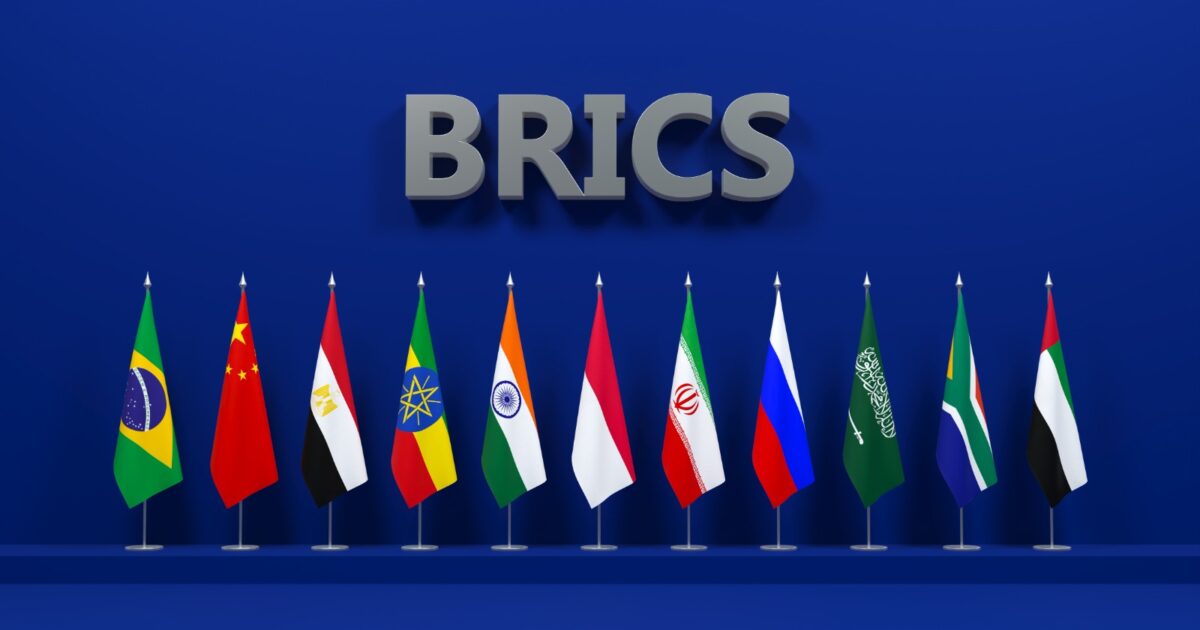
The summit was held in New Delhi, India, on 12 October 2026. It brought together leaders from the expanded BRICS membership, including Brazil, Russia, India, China, South Africa, Egypt, Ethiopia, Iran, the UAE and Indonesia. Saudi Arabia participated in an informal capacity.
Which countries are members of BRICS in 2026?
The original five members — Brazil, Russia, India, China and South Africa — have been joined by Egypt, Ethiopia, Iran, the United Arab Emirates and Indonesia. Saudi Arabia holds an informal position just short of official membership. This expansion gives BRICS significant economic and geographic weight: approximately 49.5% of the global population, around 40% of global GDP and 26% of global trade. On a PPP basis, the grouping’s combined GDP is cited at approximately USD 77 trillion, compared with around USD 57 trillion for the G7.
What are the key outcomes of the BRICS Summit 2026?
The New Delhi Declaration endorsed the BRICS Global Value Chains Action Plan 2026–2030, aiming to increase developing economies’ participation in higher-value manufacturing, technology transfer and resilient supply chains. Members reached convergence on a proposed BRICS Agreement on Cooperation and Mutual Administrative Assistance in Customs Matters, subject to national procedures. The summit advanced work on interoperability between national payment and messaging systems and greater use of local currencies, but did not establish a single BRICS currency or a fully operational common payments system. Energy cooperation included the BRICS Energy Cooperation Roadmap 2025–2030, guiding principles on smart grids and energy storage, and the BRICS Digital Centre of Excellence for Smart Grids and Energy Storage. Critical minerals cooperation focused on reliable and diversified supply chains. Technology and AI cooperation included the BRICS Science and Research Repository and quantum technologies. Logistics cooperation advanced through the BRICS Logistics Supply Chain Cooperation Framework. India proposed a BRICS Startup Innovation Fund. Bilateral outcomes included India–China restoration of direct Guangzhou–New Delhi flights and India–Russia agreement to continue their Special and Privileged Strategic Partnership, with Putin inviting Modi to Russia for the 24th Annual Summit.
What are the business impacts of the BRICS Summit 2026?
Indian exporters could benefit from lower trade friction over the medium term through customs cooperation, Authorized Economic Operator cooperation and digital trade documentation. Manufacturing and supply-chain diversification could become a significant opportunity, with potential beneficiaries including electronics, automotive, pharmaceuticals, chemicals, renewable-energy equipment, defence manufacturing and industrial machinery. Financial institutions and corporates could gain additional settlement options through payment interoperability and local-currency settlement, though conventional infrastructure will remain necessary until interoperability scales. India–China business connectivity could improve, particularly for aviation, tourism and business travel. Technology companies could gain access to new research and innovation networks through the BRICS Science and Research Repository, start-up cooperation and AI initiatives.
What should organisations and individuals do to prepare?
Monitor implementation of the New Delhi Declaration outcomes, particularly customs cooperation, supply chain frameworks and payment interoperability. Assess opportunities in critical minerals, logistics, digital infrastructure and higher-value manufacturing. Review supply chain diversification options across BRICS markets. Monitor developments in local-currency settlement and payment system interoperability for potential cost reductions. For India–China business travel, take advantage of restored direct flights and improved connectivity. Engage with BRICS research and innovation networks where relevant. Remain aware of persistent risks from geopolitical rivalries, sanctions exposure, maritime chokepoint vulnerabilities and unresolved bilateral disputes.
Frequently asked questions
When was the BRICS Summit 2026 held?
The 18th BRICS Summit was held in New Delhi, India, on 12 October 2026.
Which countries are in BRICS in 2026?
Brazil, Russia, India, China, South Africa, Egypt, Ethiopia, Iran, the UAE and Indonesia, with Saudi Arabia informal.
Did BRICS create a common currency?
No. The summit advanced payment interoperability and local-currency settlement but did not create a single BRICS currency or a fully operational common payments system.
What is the New Delhi Declaration?
It is the 140-point outcome document adopted at the 18th BRICS Summit, reaffirming the grouping’s three pillars and advancing cooperation on trade, supply chains, payments, energy, critical minerals, technology and logistics.
Download the full advisory now
MitKat’s Special Report on the BRICS Summit 2026 carries the complete agenda, outcomes, bilateral developments and business impact assessment. Download the full advisory now to brief your strategy and continuity teams.
Filed under: India-South AsiaThreat Intelligence Special Reports