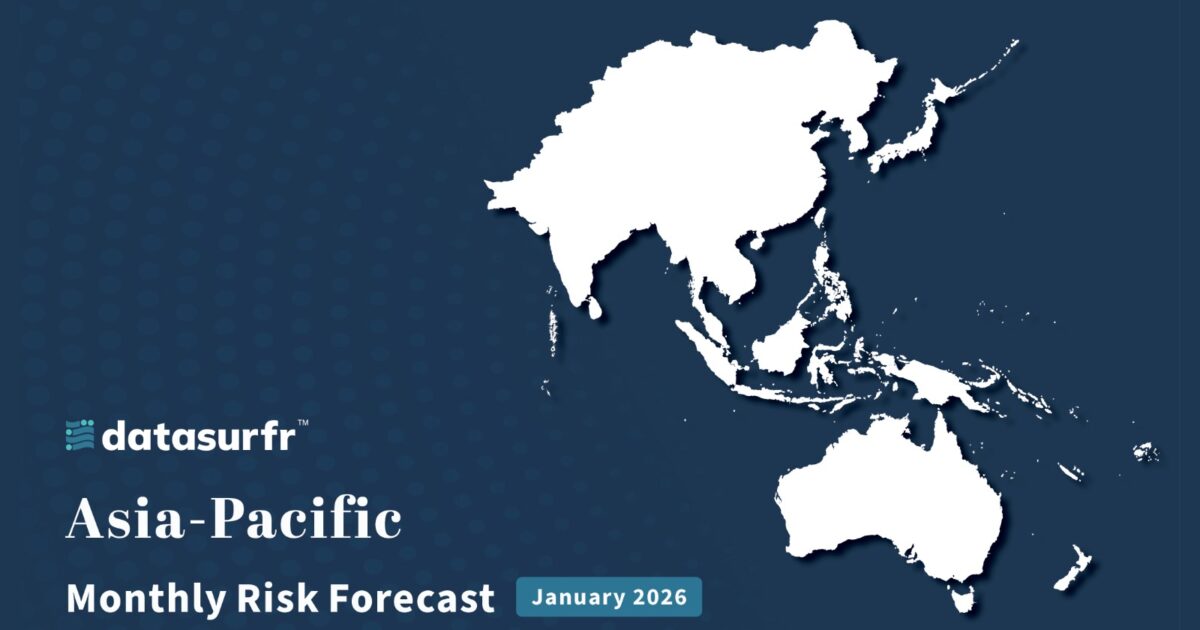
MitKat Advisory’s Asia-Pacific Monthly Risk Forecast for January 2026 brings together the region’s major diplomatic, security, health and climate developments into a single monthly briefing, supported by the datasurfr platform’s curated event monitoring.
What the Forecast covers
The forecast opens with an executive summary of the region’s outlook for January, sets out a country-by-country forecast across East Asia, Oceania and Southeast Asia, reviews high-impact developments from December, and closes with a full event calendar for the region.
A dense diplomatic and sporting calendar
A planned Japan-South Korea summit in Nara Prefecture in mid-January and the 2026 IIF China Economic Forum in Beijing on 30 January headline a busy month, alongside major sporting fixtures including the Standard Chartered Hong Kong Marathon, the Tokyo New Year Half Marathon, the Singapore Canoe Marathon and the Philippine Women’s Open, all of which bring localized travel restrictions and elevated security deployments.
Escalating maritime and cross-strait tensions
December 2025 saw confrontations between Chinese vessels and Filipino fishing boats near Sabina Shoal, reinforcing Manila’s push for a binding ASEAN Code of Conduct as it takes the 2026 ASEAN chair. Cross-Strait tensions remain elevated after China’s carrier Fujian transited the Taiwan Strait, and South Korea has updated its DMZ response guidelines to reduce ambiguity toward potential North Korean incursions.
Aviation disruption and seismic risk in Japan
Japanese Prime Minister Sanae Takaichi’s suggestion that Japan could deploy forces in a Taiwan Strait conflict triggered a diplomatic row with China that saw 1,900 China-Japan flights cancelled in December. A powerful 7.6-magnitude earthquake also struck Japan’s northeast, triggering evacuations, tsunami warnings and transport disruption that underscore the country’s ongoing seismic vulnerability.
Security incidents and civil unrest
A deadly terrorist attack at a Hanukkah celebration on Sydney’s Bondi Beach on 14 December has prompted sustained counterterrorism measures around major Australian cultural events. Southeast Asia saw renewed Thailand-Cambodia border clashes, large labour protests in Jakarta, anti-corruption rallies in Manila, and a nationwide Philippine transport strike, all pointing to continued civil unrest risk into 2026.
Climate volatility across Southeast Asia
Tropical Depression Wilma affected parts of the Philippines and forecasts point to an active cyclone season with varied rainfall patterns in early 2026. Singapore experienced flash flooding from intense rainfall, Malaysia saw widespread flooding in mid-December, and authorities across the region are stepping up maritime safety inspections during the northeast monsoon.
What businesses should do
Organizations with shipping or maritime exposure in the South China Sea and Taiwan Strait should track sanctions, patrol activity and insurance implications closely, while those with staff or facilities in Japan should reassess seismic contingency and flight-disruption plans. Firms operating in Indonesia, the Philippines and along the Thailand-Cambodia border should monitor labour unrest and civic activism, and those in Malaysia, Singapore and the Philippines should build in buffer time for monsoon-related flooding and transport disruption.
Download the report now
The Asia-Pacific Monthly Risk Forecast provides country-level detail across East and Southeast Asia, and a complete event calendar. Download the full forecast now to plan your January operations across APAC.
Filed under: APACRegional Risk Reviews