KEY TAKEAWAYS:
- August 2026 combines a dense holiday calendar with elevated weather risk across Asia-Pacific. The Hungry Ghost Festival runs as Ghost Month from 13 August to 10 September, with the main festival day on 27 August, while Japan’s Obon period (13–16 August) is expected to produce one of the year’s busiest domestic travel windows.
- National observances include South Korea’s Liberation Day (15 August), Indonesia’s 81st Independence Day (17 August), Mawlid in Brunei, Indonesia and Malaysia (25 August), Malaysia’s National Day (31 August) and the Philippines’ National Heroes Day (31 August); Singapore’s 61st National Day falls on 09 August, with 10 August the off-in-lieu holiday.
- The TCS Sydney Marathon (27–30 August, race day 30 August) expects a record 41,000 participants and extensive CBD road closures.
- The month follows a severe July: Super Typhoon Bavi hit the Philippines, Taiwan and China, Typhoon Noul struck Guangdong, a magnitude 7.1 earthquake in Kumamoto killed 13 people and halted production at major manufacturers, and a Telstra network failure disrupted Australia on 08 July.
- A strengthening El Niño raises the risk of further typhoons and, later, haze.
August 2026 puts a crowded calendar of festivals, national days and a major marathon on top of an active typhoon season and the fallout from a damaging July. Businesses with Asia-Pacific operations should expect localised crowding, access restrictions and transport pressure, with impacts that are generally short-lived and concentrated in specific places.
Which festivals and holidays should businesses plan around in August?
The Hungry Ghost Festival (Zhongyuan or Yulan) is observed across China, Macau, Hong Kong and Taiwan, with Ghost Month running from 13 August to 10 September and the main festival day on 27 August; temple precincts such as Wong Tai Sin and Longshan are expected to see evening crowds, and authorities may announce road closures, transport diversions and extra police postings near temples, cemeteries and waterfronts. Japan’s related Obon period runs from 13 to 16 August, with peak movement expected between 08 and 16 August as people travel for family gatherings and events such as Tokushima’s Awa Odori. National observances add to domestic travel: China’s Army Day on 01 August, which may coincide with military exercises in the Taiwan Strait, South Korea’s Liberation Day on 15 August, Indonesia’s 81st Independence Day on 17 August, Mawlid on 25 August in Brunei, Indonesia and Malaysia, and National Day in Malaysia and National Heroes Day in the Philippines, both on 31 August. Singapore’s 61st National Day on 09 August falls on a Sunday, so 10 August is the off-in-lieu holiday, creating a three-day weekend.
How will the TCS Sydney Marathon affect business in Sydney?
The TCS Sydney Marathon is a multi-day festival from 27 to 30 August, with the race expo at Sydney Showground, a five-kilometre mini marathon on 29 August and the 42.195 km race on 30 August, crossing the Sydney Harbour Bridge and finishing at the Opera House Forecourt. Organisers expect a record 41,000 marathon participants plus tens of thousands of spectators. Large-scale road closures, parking restrictions and diversions are likely around the Harbour Bridge, Circular Quay, Macquarie Street and The Rocks, with trains, metro, buses, ferries and light rail expected to carry substantially higher passenger volumes. Congestion is expected to peak on the morning and early afternoon of 30 August before easing as roads reopen, and hospitality, retail and tourism operators are likely to see increased demand.
What severe weather and disasters from July are still affecting operations?
Super Typhoon Bavi (Inday) intensified to a Category 5-equivalent storm in early July, with outer bands and an enhanced southwest monsoon bringing flooding and landslides to Mindanao and the Visayas before it passed near Taiwan and made landfall in Zhejiang on 11 July. The datasurfr report cites around 26 fatalities and more than 780,000 people affected in the Philippines, over 130 injuries and nearly 200 flight cancellations in Taiwan, and evacuations of more than 1.8 million people in China. Typhoon Noul later made landfall near Huidong in Guangdong on 26 July, disrupting Guangdong and Hong Kong, after Tropical Storm Maysak affected the same area earlier in the month. On 28 July, a magnitude 7.1 earthquake struck Kumamoto Prefecture, causing 13 deaths, power outages affecting about 45,000 households, and suspensions of the Kyushu Shinkansen and Kumamoto Airport; manufacturers including Toyota, Honda, Nissan, Sony Semiconductor and Renesas Electronics suspended production, and more than 100 aftershocks were recorded. With El Niño strengthening and the typhoon season still active, further storms, flooding and landslides remain possible.
What other July events still matter for business continuity?
On 08 July, a nationwide mobile network outage caused by an internal software defect in network timing and synchronisation systems disrupted Telstra customers across Sydney, Melbourne, Brisbane, Perth, Canberra and Adelaide; regional train services in Victoria and New South Wales were temporarily suspended and some payment terminals could not process transactions, and the report expects closer regulatory scrutiny of Australian telecommunications as a result. Protest activity also continued: pro-Palestinian demonstrations in several Australian cities remained largely peaceful but brought increased police presence and localised traffic disruption, student-led protests in Indonesia over fuel costs and living expenses continued, a 16 July rally by more than 7,000 Samsung Electronics union workers took place in Suwon, and Manila saw heightened security during the second impeachment trial of Vice-President Sara Duterte on 06 July.
What should businesses do to prepare?
Organisations should plan for intensified travel demand between 13 and 27 August across East Asia and allow for access restrictions and short delays near temples, cemeteries, waterfronts and transport hubs. Businesses in Sydney should map delivery and staff routes against the marathon closures ahead of 30 August, and those in Singapore should expect reduced staffing and logistics delays over the National Day long weekend, with normal operations expected to resume gradually by mid-August. Firms with exposure to southern China, Hong Kong, Taiwan, the Philippines or Kyushu should keep weather and seismic contingency plans active, and manufacturers with Kumamoto-linked supply chains should monitor restart timelines. Telecom-dependent operations in Australia should review fallback communications arrangements.
Frequently asked questions
When is the Hungry Ghost Festival in 2026?
Ghost Month runs from 13 August to 10 September 2026, with the main festival day on 27 August in China, Hong Kong and Taiwan; Japan’s related Obon festival is observed mainly between 13 and 16 August.
When is the TCS Sydney Marathon and which areas will be closed?
The festival runs 27–30 August with race day on 30 August; road closures are likely around the Sydney Harbour Bridge, Circular Quay, Macquarie Street and The Rocks, with congestion expected to peak in the morning and early afternoon of race day.
What caused the July Australia mobile outage?
The datasurfr report attributes the 08 July outage to an internal software defect affecting network timing and synchronisation systems, which disrupted mobile data, voice and calling for millions of Telstra customers.
Download the full report now
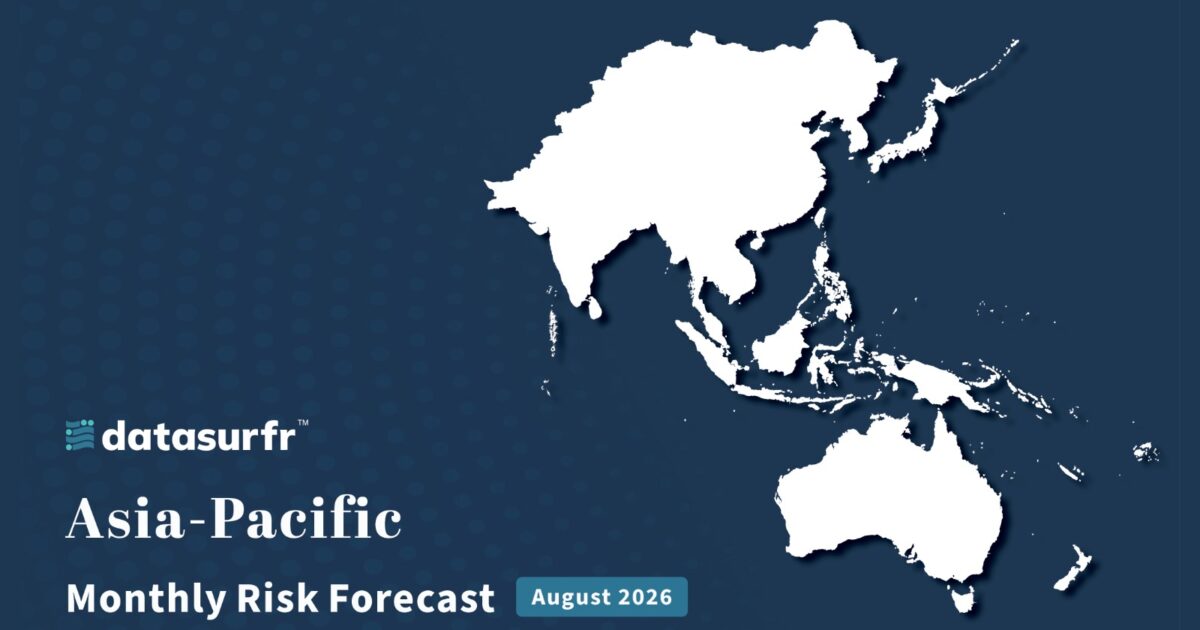
datasurfr’s Asia-Pacific Monthly Risk Forecast for August 2026 carries the complete country-by-country breakdown, event-impact detail and a full regional event calendar. Download the full report now to brief your risk and continuity teams.
Filed under: APACRegional Risk Reviews