KEY TAKEAWAYS:
- A 25-hour Anak Krakatau eruption (4-6 September) closed eight airports and shut Jakarta’s Soekarno-Hatta for close to two days, grounding 2,961 flights and stranding 341,000 passengers.
- The eruption landed on top of a four-month Karhutla fire and haze emergency that has burned roughly 286,000 hectares and pushed Sarawak’s API to 521, triggering a district emergency.
- 50,891 haze-linked ISPA cases have been recorded in Indonesia, with 5.5 million people smoke-exposed across Borneo and Sumatra.
- Both hazards remain live: Anak Krakatau stays at Alert Level III with further eruptions assessed as highly likely, and an intensifying El Niño plus a positive Indian Ocean Dipole raise the risk of a worse October.
The Anak Krakatau Karhutla haze crisis 2026 saw two unrelated hazards converge inside a single week. A continuous Anak Krakatau eruption from 4-6 September closed Indonesia’s principal air gateway just as a fire and haze emergency, escalating since May, pushed air quality to emergency thresholds across Borneo, Singapore and the southern Philippines. Almost all measurable loss was operational and economic rather than physical, concentrated in grounded aircraft, stranded workforces and a regional health burden.
What happened at Anak Krakatau?
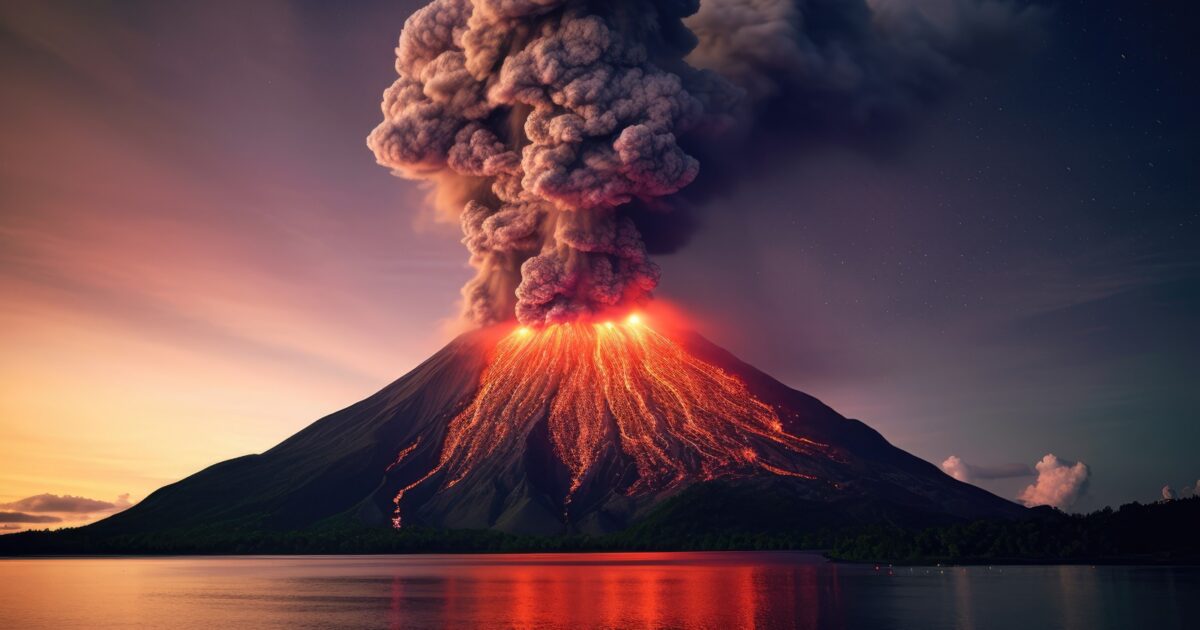
Anak Krakatau entered a continuous eruption phase at 23:07 on 4 September, with Strombolian-to-Vulcanian activity and detonations audible up to 700 km away. The ash column reached 15,000 m on the Sumatra side and 6,000 m on the Java side, prompting ash advisories for eight airports. Soekarno-Hatta (CGK), Jakarta’s main gateway, suspended operations from 06:30 on 6 September and stayed closed for roughly two days, with six of eight affected airports reopened by early 8 September and the volcano held at Alert Level III.
How bad was the aviation and travel impact?
The closure grounded 2,961 flights and stranded around 341,000 passengers, with Indonesian carriers losing an estimated Rp 19 billion (about US$1.1 million) a day. No local mitigation existed at CGK: alternate airports such as Kertajati, Ahmad Yani and Juanda sit 130-650 km away and could not absorb the hub’s throughput, so backlog recovery typically runs three to five days past reopening.
How severe is the Karhutla haze crisis?
Roughly 286,000 hectares have burned nationwide from January to late August, releasing about 46 million tonnes of CO2 in August and early September alone. Indonesia’s Health Ministry has recorded 50,891 haze-linked ISPA cases, with 5.5 million people smoke-exposed across Borneo and Sumatra. Sarawak’s API peaked at 521 in Serian, triggering a district emergency and the closure of 647 schools, while Singapore recorded its first Unhealthy PSI reading since October 2023.
Why does the haze crisis keep recurring?
About 74% of Kalimantan’s fire hotspots sit inside palm-oil and industrial-timber concessions, and clearing land by fire costs roughly 95% less than mechanical clearing. Enforcement has fallen disproportionately on individuals, with 112 arrests and 167 cases against smallholders and labourers against just five licence suspensions and an early-stage 19-company investigation — leaving the underlying economic incentive largely unchanged for 2027.
What should organisations do now?
Organisations with Jakarta air dependency, Kalimantan or Sumatra operations, or supply chains routed through the Sunda Strait should map single-node dependencies, pre-agree alternate routing through Surabaya, Semarang and Kertajati, and stock respiratory PPE to a four-week buffer. Index-based trigger thresholds for outdoor work, remote work and event cancellation should be published now, since the fire season remains open and Anak Krakatau is assessed as highly likely to erupt again.
Frequently asked questions
How many flights were grounded by the Anak Krakatau eruption?
2,961 flights were grounded and roughly 341,000 passengers stranded across eight airports between 5 and 8 September 2026.
Is the Karhutla haze crisis over?
No. The fire season remains open, an intensifying El Niño and positive Indian Ocean Dipole raise the risk of conditions worsening into October, and Anak Krakatau remains at Alert Level III.
Which regions are most affected by the haze?
Indonesia’s Borneo and Sumatra haze belt, Malaysia’s Sarawak and Sabah, Singapore, Brunei and the southern Philippines, with smoke forecast toward southern Thailand, Cambodia and Vietnam.
Download the full report now
MitKat’s Post-Incident Report on the Anak Krakatau eruption and Karhutla haze crisis carries the full dual-track chronology, health and environmental impact data, sector-by-sector business exposure, print-ready Do’s and Don’ts, and a three-phase continuity checklist with named owners. Download the full report now to brief your risk, operations and continuity teams.
Filed under: APACThreat Intelligence Special Reports