
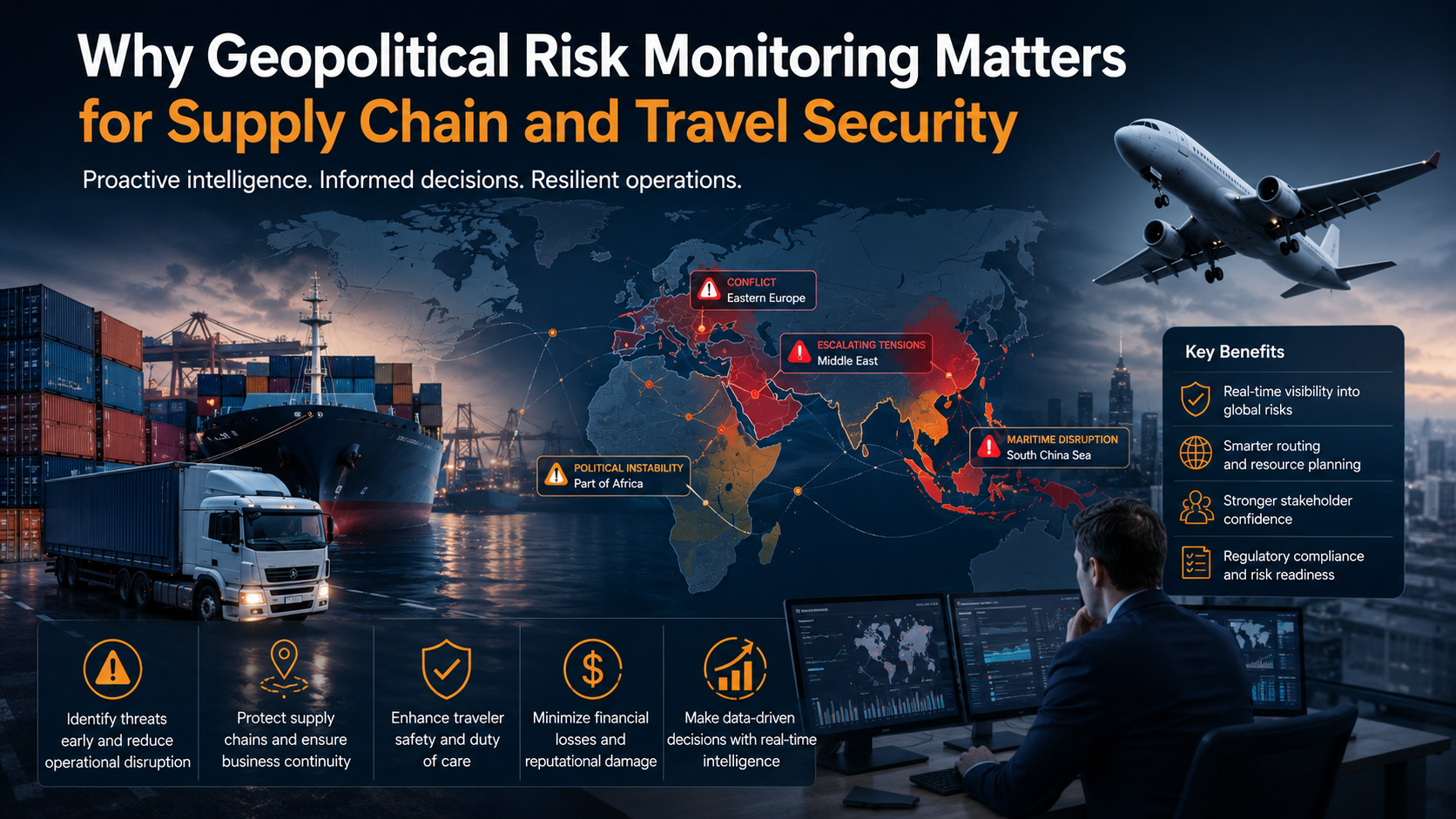
In 2026, business firms are projected to be operating in a world where geopolitical turmoil may impede operations at any time. Political instability, armed conflicts, cyber warfare, sanctions, trade restrictions, regional tensions, and shifting global alliances are creating significant challenges for multinational organizations, global supply chains, and corporate travel.
A single geopolitical event can delay shipments, ground flights, put the safety of the workforce at risk, disrupt logistics, and throw operations back by leaps and bounds. As trade conflicts mount, and economic policy and regional disputes disrupt global markets, businesses with highly globalized supply networks are re-evaluating their strategies to reduce risk and increase resilience. Political equilibrium, trade access, operational security, and long-term resilience are now as important in sourcing, production, logistics, and investment decisions, taking supply chains beyond being driven purely by cost and efficiency.
This has spurred companies to make investment decisions progressively more in real-time geopolitical intelligence and risk monitoring to improve visibility, increase resilience, safeguard business continuity, and support both supply chain management and travel security strategies in today’s fast-changing global environment.
What Is Geopolitical Risk Monitoring?
Geopolitical risk monitoring is the process of tracking and analyzing political, economic, security, and social developments that may affect business operations.
Modern monitoring platforms use the following:
- Real-time intelligence feeds
- AI-powered analytics
- Government advisories
- Global news monitoring
- Cyber threat intelligence
- Transportation and logistics data
These systems help businesses identify emerging threats early and respond before disruptions escalate.
Why Geopolitical Risks Are Increasing
Global operations have become more interconnected than ever. While globalization creates business opportunities, it also increases exposure to international risks.
Some of the most common geopolitical threats affecting businesses include:
- Political protests and civil unrest
- International conflicts and military escalation
- Economic sanctions and trade restrictions
- Terror threats and regional instability
- Cyberattacks targeting infrastructure
- Border closures and transportation disruptions
These events can quickly affect supply chains, employee mobility, and customer operations across multiple countries.
The Impact on Supply Chains
Global supply chains are highly sensitive to geopolitical instability. Manufacturing delays, shipping disruptions, port closures, and trade restrictions can interrupt business operations and increase costs.
Key supply chain risks include the following:
- Delayed cargo movement
- Disrupted manufacturing operations
- Increased transportation costs
- Limited access to critical materials
- Port and border congestion
- Supplier instability in high-risk regions
Without proper monitoring, businesses may struggle to respond quickly to disruptions and maintain operational continuity.
How Geopolitical Intelligence Protects Supply Chains
1. Real-Time Visibility
Real-time monitoring platforms provide businesses with live updates on disruptions affecting shipping routes, ports, suppliers, and logistics networks.
This visibility allows organizations to:
- Identify affected regions quickly
- Reroute shipments proactively
- Adjust sourcing strategies
- Reduce delays and operational downtime
Faster awareness improves supply chain resilience during crises.
2. Predictive Risk Analysis
AI-powered geopolitical intelligence systems can analyze historical patterns and emerging developments to predict potential disruptions before they happen.
Predictive analytics helps businesses:
- Anticipate trade restrictions
- Prepare for transportation disruptions
- Evaluate supplier risks
- Improve contingency planning
This proactive approach minimizes the impact of unexpected events.
Companies increasingly use geopolitical monitoring to evaluate supplier exposure in unstable regions.
3. Supplier Risk Management
Organizations can assess the following:
- Political stability in supplier locations
- Regional conflict risks
- Infrastructure reliability
- Regulatory and sanctions exposure
This helps businesses diversify suppliers and reduce dependency on high-risk areas.
Why Geopolitical Monitoring Matters for Travel Security
Corporate travel is also becoming more vulnerable to geopolitical instability. Employees traveling internationally may face protests, transportation disruptions, border restrictions, cyber threats, or security incidents.
Travel security teams now rely heavily on real-time intelligence to protect employees and maintain operational continuity.
How Businesses Use Geopolitical Intelligence for Travel Security
1. Real-Time Travel Alerts
Organizations use monitoring platforms to receive instant alerts about:
- Political protests and civil unrest
- Flight cancellations and airport disruptions
- Border closures and visa restrictions
- Terror threats and regional conflicts
- Severe weather and emergency incidents
These alerts help businesses make rapid travel decisions and protect employees.
2. Traveler Tracking and Visibility
Modern travel risk management systems allow organizations to monitor employee locations during business trips.
This helps companies:
- Identify travelers in affected areas
- Coordinate emergency support quickly
- Provide evacuation guidance if needed
- Maintain communication during crises
Real-time visibility improves emergency response capabilities.
3. Strengthening Duty of Care
Organizations have a legal and ethical responsibility to protect employees during business travel.
Geopolitical risk monitoring strengthens duty of care by helping companies
- Continuously assess travel threats
- Provide rapid safety updates
- Reduce traveler exposure to risk
- Improve crisis response coordination
A proactive approach improves both employee safety and organizational resilience.
The Role of AI in Geopolitical Risk Monitoring
Artificial intelligence is transforming how businesses manage geopolitical risks in 2026.
AI-powered systems can:
- Analyse global events in real time
- Detect emerging threat patterns
- Predict disruptions before escalation
- Automate emergency alerts
- Improve operational decision-making
AI enables businesses to move from reactive crisis management to proactive risk prevention.
Industries That Depend on Geopolitical Monitoring
Several industries rely heavily on geopolitical intelligence for supply chain and travel security, including:
- Logistics and transportation companies
- Manufacturing and industrial firms
- Energy and infrastructure sectors
- Technology and telecommunications organizations
- Financial services and banking
- Healthcare and pharmaceutical companies
For these industries, disruptions can directly affect revenue, operations, and customer commitments.
Best Practices for Businesses
To improve supply chain and travel resilience, organizations should:
- Implement real-time geopolitical intelligence platforms
- Conduct regular regional risk assessments
- Diversify suppliers and logistics routes
- Establish crisis communication protocols
- Integrate travel security into business continuity planning
- Use predictive analytics for strategic decision-making
Preparedness and proactive monitoring are essential in today’s global risk environment.
The Future of Geopolitical Risk Management
As geopolitical uncertainty continues to grow, businesses will increasingly rely on AI-driven monitoring, predictive analytics, and integrated intelligence systems to protect operations.
Future risk management strategies will focus on:
- Real-time operational visibility
- Automated threat detection
- Predictive supply chain analytics
- Advanced traveler safety platforms
- Integrated cyber and geopolitical intelligence
Organizations that invest in these capabilities will be better positioned to navigate disruption and maintain long-term resilience.
FAQ’s
- How do geopolitical risks affect supply chains?
Democracy, trade connectivity, operational security, and longevity are now recognized as important in sourcing, production, logistics, and investment decisions, taking supply chains beyond being driven purely by cost and efficiency. This has spurred companies to make investment decisions progressively more in real-time geopolitical intelligence and risk monitoring to improve visibility, increase resilience, safeguard business continuity, and support both supply chain management and travel security strategies in today’s fast-changing global environment.
- Why is geopolitical monitoring important for travel security?
Beyond that, geopolitical monitoring can aid companies in significantly monitoring the safety of their employees by undertaking real-time alerts and more robust emergency response. In the course of international travel, travelers may face risks that incorporate political turmoil, transportation breakdowns and border closures, cyber threats, or regional conflicts.
Conclusion
Geopolitical risk monitoring has become a critical business function for managing supply chain and travel security in 2026. By combining real-time intelligence, predictive analytics, and proactive risk management strategies, businesses can reduce disruptions, protect employees, and strengthen operational continuity.
In an increasingly unpredictable global environment, organizations that prioritize geopolitical intelligence will gain a significant advantage in resilience, decision-making, and long-term business stability.
Share on WhatsApp