
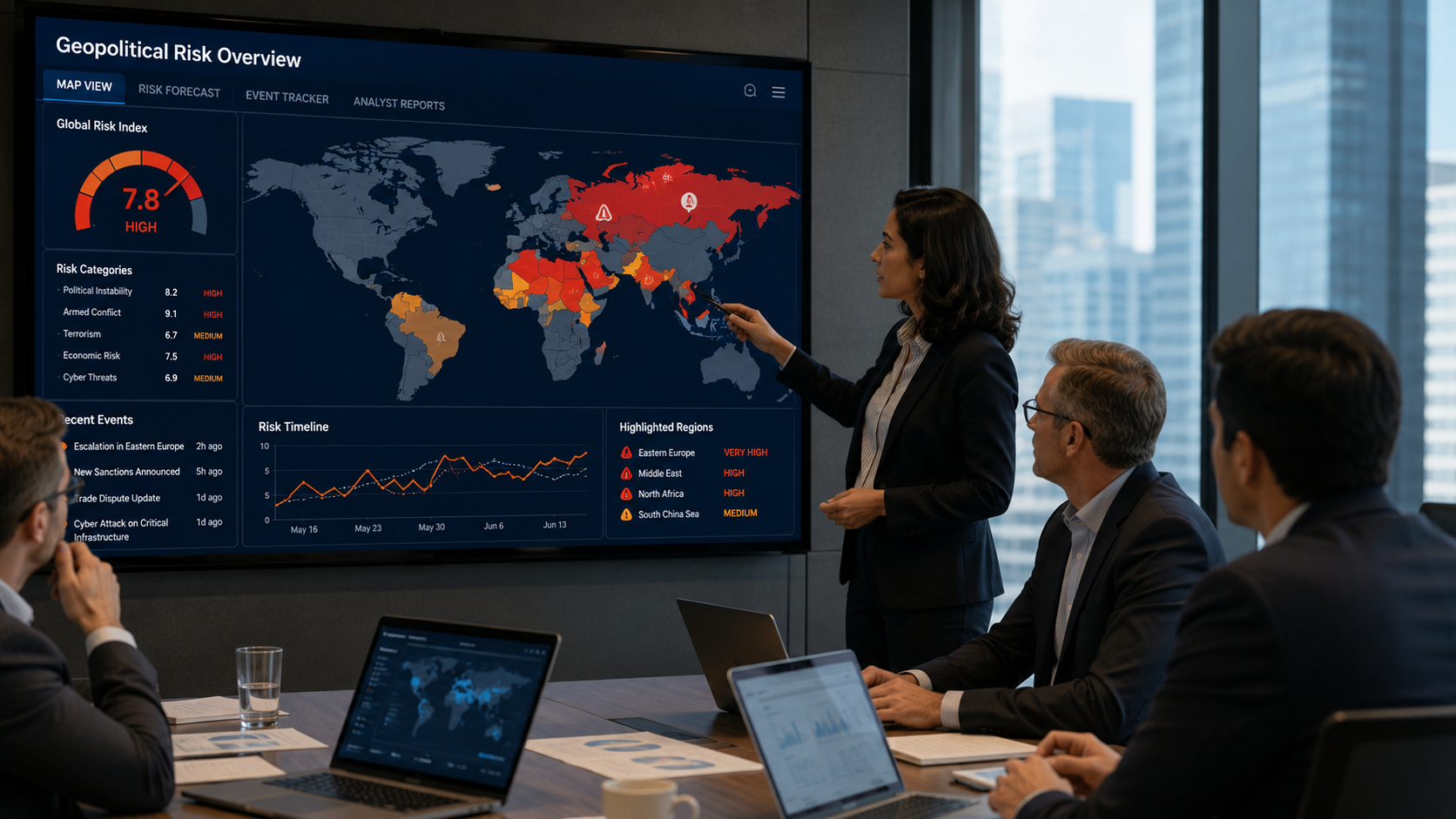
In 2026, businesses are operating in a more volatile global environment. Geopolitical turmoil, regional disagreements, cyber warfare, sanctions pertaining to the economy, political unrest, and supply chain disruptions are all factors in this landscape. Organizations are rapidly integrating AI-powered and machine learning-driven real-time geopolitical intelligence to grapple with these changing risks. Such advanced systems allow enterprises to track global events constantly, analyze emerging trends, simulate risk scenarios, and generate predictive insights that help in faster and more strategic decision-making. Geopolitical intelligence has emerged as a critical pillar of enterprise risk management, offering capabilities such as real-time threat monitoring, scenario planning, cybersecurity integration, and financial risk analysis.
What Is Real-Time Geopolitical Intelligence?
Real-time geopolitical intelligence refers to the continuous monitoring and analysis of global political, economic, security, and social developments that may impact business operations.
Advanced intelligence platforms collect and analyze data from multiple sources, including:
- Global news and media outlets
- Government advisories and policy updates
- Social media and public sentiment
- Security and threat intelligence feeds
- Economic and trade indicators
- Cybersecurity monitoring systems
Using AI-powered analytics, these systems help organizations identify emerging threats and respond before disruptions escalate.
Why Geopolitical Intelligence Matters for Businesses
Global businesses face a wide range of risks that can affect operations, workforce safety, and supply chains.
Some of the most common geopolitical risks include:
- Political unrest and protests
- International conflicts and regional instability
- Economic sanctions and trade restrictions
- Cyberattacks and digital espionage
- Border closures and transportation disruptions
- Energy and commodity market instability
Without real-time intelligence, businesses may struggle to adapt quickly to changing conditions and may face operational, financial, or reputational damage.
How Businesses Use Real-Time Geopolitical Intelligence
1. Protecting Employees and Corporate Travelers
One of the most important uses of geopolitical intelligence is employee safety. Companies use real-time monitoring systems to track global threats affecting business travelers and international employees.
Organizations can receive alerts about:
- Civil unrest and protests
- Terror threats and regional conflicts
- Severe weather and emergency incidents
- Airport disruptions and transportation risks
This allows businesses to reroute travelers, delay trips, or activate emergency response plans when necessary.
2. Managing Supply Chain Risks
Global supply chains are highly vulnerable to geopolitical disruptions. Political instability, sanctions, trade disputes, and transportation disruptions can delay shipments and increase operational costs.
Real-time intelligence helps organizations:
- Identify supply chain vulnerabilities
- Monitor critical trade routes and ports
- Predict disruptions before they occur
- Develop alternate sourcing strategies
Businesses using proactive monitoring are better prepared to maintain continuity during global crises.
3. Supporting Strategic Decision-Making
Executives and risk management teams rely on geopolitical intelligence to make informed business decisions.
Real-time insights help organizations evaluate:
- Market stability and investment risks
- Expansion opportunities in emerging markets
- Regional security conditions
- Regulatory and policy changes
This allows leadership teams to make faster and more accurate strategic decisions.
4. Strengthening Crisis Response
During global emergencies, fast response is critical. Real-time geopolitical monitoring enables organizations to identify threats early and coordinate crisis management activities efficiently.
Modern intelligence platforms support:
- Automated emergency alerts
- Real-time incident tracking
- Centralized communication systems
- Integrated crisis management dashboards
This improves coordination across security, operations, HR, and leadership teams during high-risk situations.
5. Enhancing Cybersecurity Preparedness
Geopolitical conflicts increasingly involve cyber warfare and digital threats. Businesses now face higher risks of ransomware attacks, data breaches, and cyber espionage during periods of international tension.
Geopolitical intelligence helps organizations:
- Monitor cyber threat activity globally
- Identify region-specific cyber risks
- Protect critical infrastructure and systems
- Strengthen cybersecurity response strategies
Integrating cyber intelligence with geopolitical monitoring improves overall enterprise security.
The Role of AI in Geopolitical Risk Monitoring
Artificial intelligence is transforming how organizations analyze global risks. AI-powered systems can process massive volumes of information in real time, identify patterns, and predict emerging threats.
AI helps businesses by:
- Detecting unusual geopolitical developments
- Predicting supply chain disruptions
- Automating threat alerts
- Improving risk forecasting accuracy
- Supporting faster operational decisions
This allows companies to move from reactive risk management to proactive resilience planning.
Industries Benefiting from Geopolitical Intelligence
Several industries rely heavily on real-time geopolitical monitoring, including:
- Logistics and supply chain companies
- Energy and infrastructure sectors
- Financial services and banking
- Technology and telecommunications firms
- Manufacturing and global retail organizations
- Healthcare and pharmaceutical companies
For these industries, geopolitical disruptions can directly impact operations, revenue, and customer service.
Best Practices for Businesses
Organizations looking to strengthen geopolitical risk management should:
- Implement real-time intelligence platforms
- Integrate geopolitical monitoring into business continuity plans
- Establish crisis communication protocols
- Conduct regular regional risk assessments
- Use predictive analytics for strategic planning
- Monitor both physical and cyber threats simultaneously
A proactive intelligence strategy improves resilience and operational agility.
The Future of Geopolitical Risk Management
As global uncertainty continues to rise, geopolitical intelligence will become even more important for businesses operating across international markets.
Future risk management strategies will increasingly rely on the following:
- AI-driven predictive analytics
- Automated threat detection systems
- Real-time operational dashboards
- Integrated cyber and geopolitical intelligence
- Advanced global monitoring technologies
Organizations that invest in these capabilities will be better prepared to manage disruptions and maintain competitive stability.
FAQ’s
1. What is real-time geopolitical intelligence, and why is it important for businesses?
Real-time geopolitical intelligence is the continuous monitoring and analysis of global political, economic, and security developments to anticipate their impact on business operations, supply chains, investments, and market strategies. It helps companies move from reactive risk management to proactive decision-making, reducing surprises, safeguarding assets, and identifying strategic opportunities.
2. How frequently should businesses assess geopolitical risks?
- Weekly to monthly: – For fast-moving global developments.
- Quarterly or semiannual: – Strategic scenario reviews for long-term investment and operational decisions.
- Ad-hoc: – Immediate briefings during crises or unexpected events to ensure timely executive response.
Conclusion
Real-time geopolitical intelligence is transforming how businesses manage global risks in 2026. By combining live monitoring, AI-powered analytics, and predictive insights, organizations can protect employees, secure supply chains, improve decision-making, and strengthen crisis response capabilities.
In an increasingly volatile global environment, businesses that adopt proactive geopolitical risk management strategies will be better equipped to maintain resilience, continuity, and long-term operational success.
Share on WhatsApp