
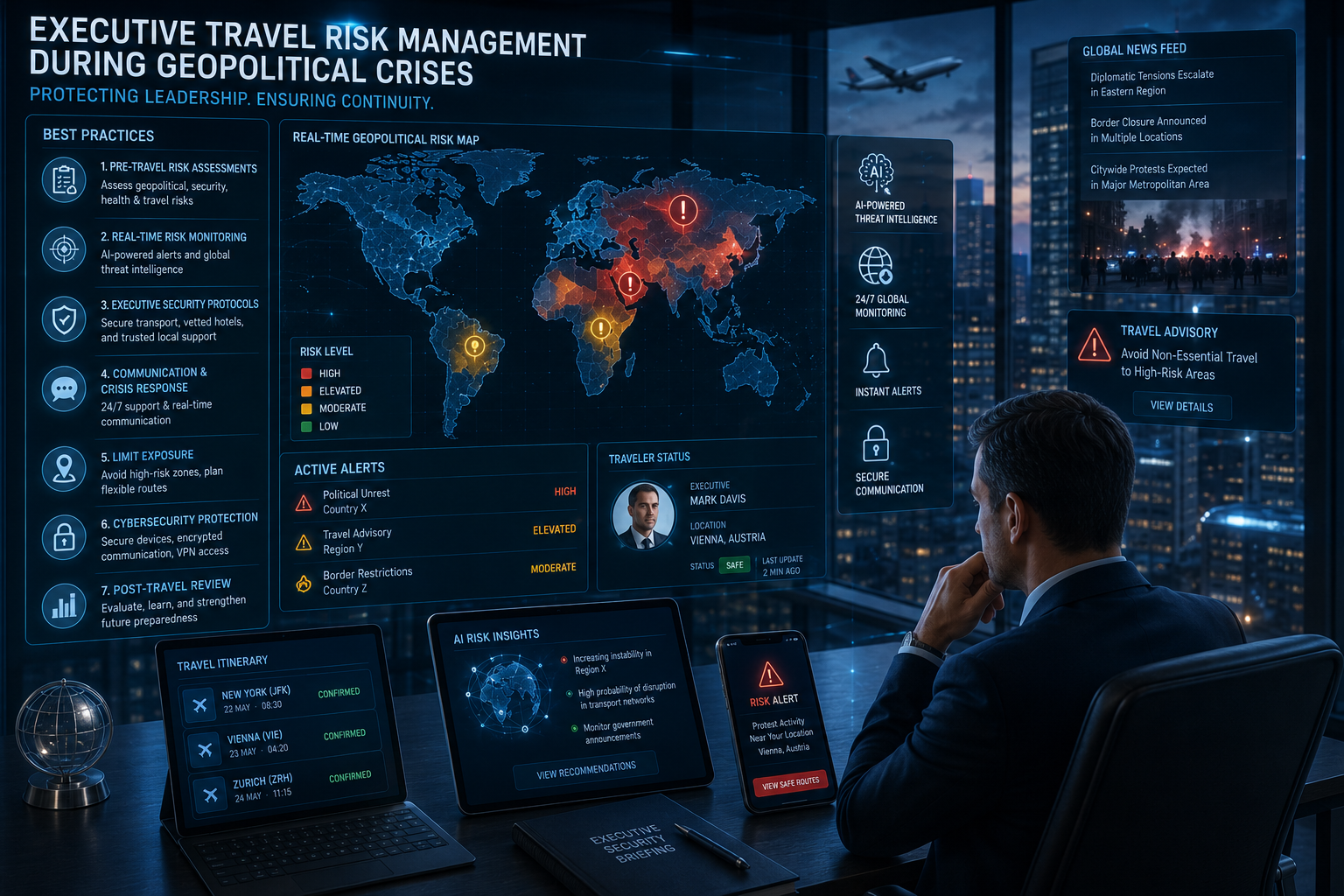
Executive Travel Risk Management (TRM) is a strategic and structured process designed to protect senior executives from physical, health, cyber and logistical threats during business travel. It goes beyond travel planning by identifying, mitigating, and continuously monitoring risks before, during, and after travel to ensure executive safety, operational continuity, and organizational resilience.
In today’s unpredictable global environment, executive travel has become increasingly vulnerable to geopolitical crises. Political instability, armed conflicts, diplomatic tensions, protests, sanctions, and sudden border restrictions can rapidly disrupt international business travel and place executives at significant risk.
For multinational organizations, protecting senior leadership during travel is now a critical part of corporate security and business continuity planning. Executives often carry strategic responsibilities, sensitive information, and decision-making authority that make them high-value targets during periods of geopolitical instability.
As global risks continue to evolve in 2026, companies must adopt proactive and technology-driven approaches to executive travel risk management.
Why Geopolitical Crises Increase Travel Risks
Geopolitical events can escalate with little warning and affect transportation networks, public safety, and communication systems across entire regions.
Common geopolitical threats impacting executive travel include:
- Political protests and civil unrest
- Military conflicts and regional tensions
- Terror threats and targeted attacks
- Government sanctions and diplomatic disputes
- Border closures and visa restrictions
- Transportation disruptions and infrastructure shutdowns
Executives traveling internationally may face increased exposure due to their visibility, corporate affiliation, and travel patterns.
Without proper risk management strategies, organizations may struggle to protect key personnel during rapidly changing situations.
The Importance of Executive Travel Risk Management
Executive travel risk management involves identifying, monitoring, and mitigating risks before, during, and after travel. The goal is to ensure leadership safety while maintaining operational continuity during geopolitical crises.
A strong travel security strategy helps organizations:
- Protect executives from physical and cyber threats
- Maintain uninterrupted business operations
- Improve emergency response capabilities
- Reduce reputational and financial risks
- Strengthen corporate duty of care compliance
In high-risk environments, even a minor disruption can quickly escalate into a serious operational challenge.
Best Practices for Managing Executive Travel Risks
1. Conduct Pre-Travel Risk Assessments
Before approving executive travel, companies should perform detailed risk assessments for the destination.
This includes evaluating:
- Political stability
- Crime and security conditions
- Current protests or unrest
- Health and infrastructure risks
- Local transportation reliability
- Cybersecurity threats
Pre-travel intelligence helps organizations determine whether travel should proceed, be postponed, or require additional security measures.
2. Use Real-Time Travel Monitoring
Geopolitical situations can change within minutes. Real-time travel monitoring platforms provide live updates on security threats, protests, transportation disruptions, and emergency incidents.
Modern AI-powered systems allow organizations to:
- Track executive locations in real time
- Receive instant threat alerts
- Monitor regional developments continuously
- Respond rapidly during emergencies
Live intelligence significantly improves decision-making and crisis response.
3. Develop Executive Travel Security Protocols
Companies should establish clear executive protection procedures for high-risk travel scenarios.
These protocols may include:
- Secure transportation arrangements
- Vetted hotels and travel routes
- Emergency evacuation plans
- Local security support teams
- Backup communication systems
Having structured security procedures reduces confusion and improves preparedness during crises.
4. Strengthen Communication and Crisis Response
Effective communication is critical during geopolitical disruptions. Organizations should maintain secure communication channels with traveling executives at all times.
Best practices include:
- 24/7 travel support teams
- Emergency notification systems
- Satellite or backup communication tools
- Clear escalation and reporting procedures
Fast communication allows businesses to coordinate support and make rapid operational decisions.
5. Limit Exposure Through Travel Planning
Reducing unnecessary exposure is one of the most effective ways to protect executives.
Organizations can minimize risks by:
- Avoiding high-risk zones and protest areas
- Limiting public visibility of travel plans
- Using flexible travel schedules and alternate routes
- Reducing dependence on unstable transit hubs
Strategic travel planning helps lower the likelihood of disruption or targeted threats.
6. Integrate Cybersecurity into Travel Protection
Geopolitical crises often involve increased cyber risks, including surveillance, phishing attacks, and compromised networks.
Executives traveling internationally should use:
- Encrypted communication tools
- VPN-secured internet access
- Protected corporate devices
- Multi-factor authentication systems
Cybersecurity is now a critical component of executive travel risk management.
7. Conduct Post-Travel Reviews
After travel is completed, organizations should review incidents, response effectiveness, and operational challenges.
Post-travel analysis helps companies:
- Improve future risk planning
- Update security procedures
- Identify emerging geopolitical trends
- Strengthen organizational resilience
Continuous improvement is essential in a rapidly evolving global threat environment.
The Role of Technology in Executive Travel Security
Technology is transforming executive protection strategies in 2026. Companies are increasingly using:
- AI-powered risk intelligence platforms
- Predictive geopolitical analytics
- GPS-based traveller tracking
- Automated emergency alert systems
- Integrated crisis management dashboards
These tools provide organizations with greater visibility, faster response capabilities, and improved situational awareness.
The Future of Executive Travel Risk Management
As geopolitical instability continues to affect global business operations, executive travel security will become even more important. Organizations that invest in proactive monitoring, predictive intelligence, and crisis preparedness will be better positioned to protect leadership teams during uncertain situations.
Executive travel risk management is no longer just a security function — it is a strategic business priority tied directly to resilience, continuity, and organizational stability.
FAQ’s
1.What is executive travel risk management?
Executive travel risk management refers to the strategies, technologies, and security measures to organisations use to protect senior executives during domestic and international business travel.
2. What is the future of executive travel risk management?
The future of executive travel security will increasingly rely on AI-driven intelligence, predictive analytics, automated crisis response systems, and integrated risk monitoring platforms.
Conclusion
Geopolitical crises present serious challenges for executive travel in today’s interconnected world. Companies must move beyond traditional travel management and adopt comprehensive risk management strategies that combine real-time intelligence, proactive planning, cybersecurity, and emergency response preparedness.
By implementing strong executive travel risk management practices, organizations can protect leadership teams, minimize operational disruption, and navigate global uncertainty with greater confidence and resilience.
Share on WhatsApp