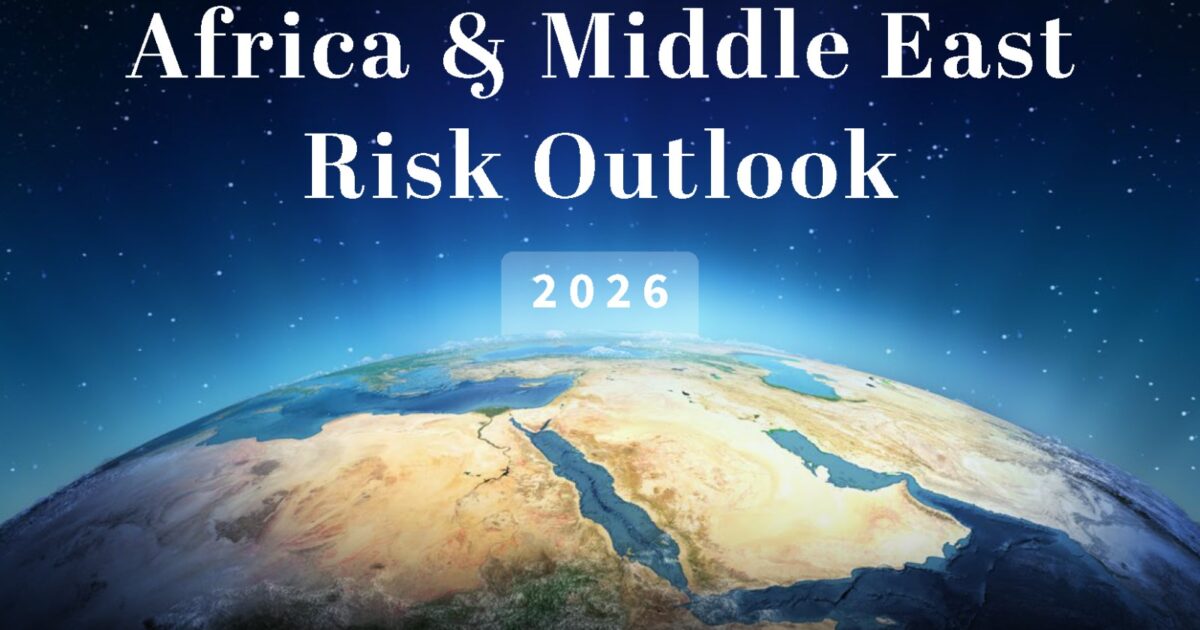
Africa and the Middle East enter 2026 with a wide risk spread. The Africa & Middle East Risk Outlook 2026, MitKat Advisory’s annual regional forecast, profiles 39 markets one by one — because Gulf states managing episodic security shocks and Sahel-adjacent economies managing structural instability need different plans, not one posture.
What does the Africa & Middle East Risk Outlook 2026 cover?
Each country profile names its top three risk drivers, sets out population, area and GDP, and closes with a 2026 outlook and specific business implications.
Which risks recur most across Africa and the Middle East?
Climate, water and natural-hazard risk appears more often than any other theme across the 39 profiles. Political and civil unrest is second, ahead of geopolitical and security spillover, then energy and infrastructure fragility and cyber risk. Unlike Europe, where cyber ranked second, unrest and physical infrastructure outweigh digital exposure here.
How exposed are the region’s trade corridors?
Two chokepoints shape logistics planning. Red Sea attacks forced large-scale rerouting around the Cape of Good Hope through 2025, cutting Suez Canal traffic and revenues; the report expects only partial normalisation until maritime security improves. In the Gulf, carriers avoided the Strait of Hormuz after the June 2025 Iran–Israel escalation, lifting hull and war-risk insurance premiums.
Which 2026 elections should businesses plan around?
Several national votes fall inside the planning year, including Uganda’s general election on 15 January, Zambia’s in August and Bahrain’s parliamentary election in November. Each brings a window of restricted assembly, movement disruption and heightened security posture.
What should businesses do?
Plan for physical disruption first: test backup power and water, harden sites against flood and heat, and diversify suppliers on exposed corridors. Then layer on election-window continuity plans, longer inventory cover where Suez or Hormuz routing matters, and compliance readiness as data-protection rules tighten across the region.
Frequently asked questions
Which countries does the Africa & Middle East Risk Outlook 2026 cover?
39 markets: 26 in Africa, from Algeria and Egypt to South Africa and Zambia, and 13 in the Middle East, including Saudi Arabia, the UAE, Israel, Iran and Yemen.
What is the biggest risk in Africa and the Middle East in 2026?
Climate, water and natural-hazard exposure is flagged most often, with flooding, heat and drought disrupting power, water and transport. Political and civil unrest is the closest second.
How is Red Sea disruption affecting trade?
Attacks through 2025 pushed vessels around the Cape of Good Hope, cutting Suez traffic and lengthening supply chains. The report expects continued volatility in Bab al-Mandeb and the southern Red Sea.
Download the full report now
What is inside
- The Africa & Middle East Risk Outlook 2026 profiles 39 countries — 26 in Africa, 13 in the Middle East — each with its own risk drivers and 2026 outlook.
- Climate, water and natural-hazard risk is flagged more often than any other risk, followed by political and civil unrest.
- Two maritime chokepoints dominate corridor risk: the Red Sea and Bab al-Mandeb, and the Strait of Hormuz.
- Infrastructure is the second most common single risk tag, with load shedding recurring from Egypt to Botswana and Eswatini.
Filed under: EMEARegional Risk Reviews