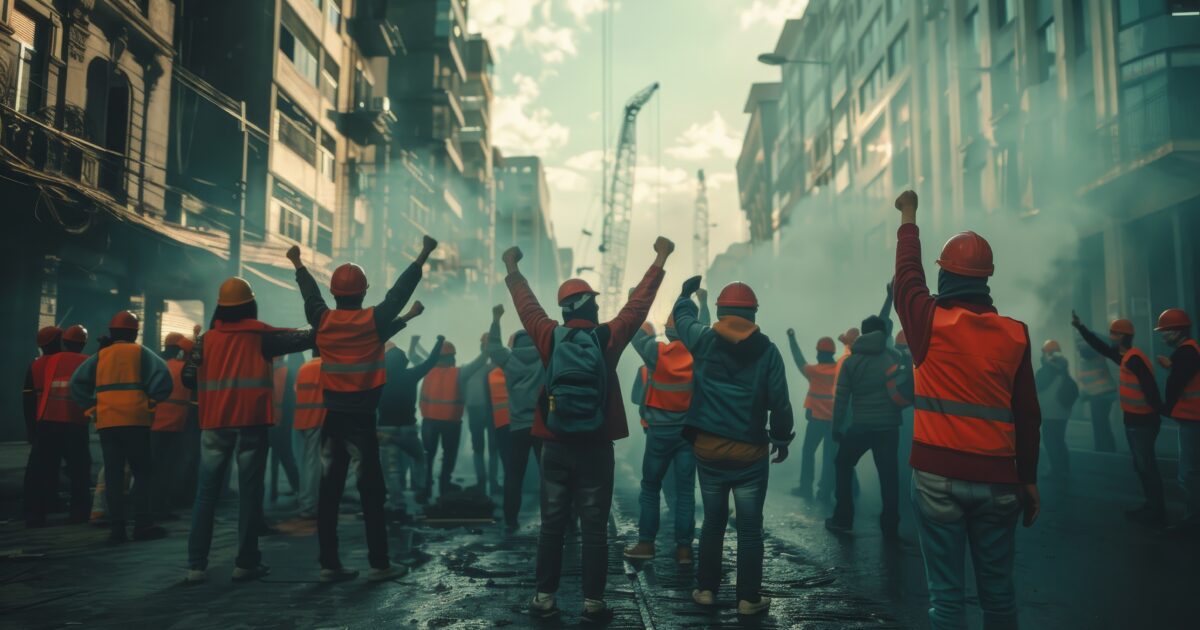
Central trade unions have called for a nationwide general strike on 12 February to protest the government’s labour reform initiative, which consolidated 29 existing labour laws into four codes covering wages, industrial relations, social security, and occupational safety. MitKat’s Special Advisory for February 2026 captured a period in which unions representing an estimated 30 crore workers, alongside farmer and student organisations, mobilised across more than 600 districts, prompting businesses nationwide to plan for widespread but variable disruption to labour, banking and transport services.
A nationwide mobilisation across sectors
The strike has been organised by a joint platform of AITUC, INTUC, HMS, CITU, AICCTU and other central trade unions, alongside the Samyukta Kisan Morcha and allied farmer bodies, spanning banking, power, telecommunications, railways, ports, insurance, welfare-scheme workers and education. Beyond opposition to the four labour codes, unions have cited concerns over privatisation and disinvestment under the New Public Sector Enterprise Policy, farmers’ objections to the proposed India-United States trade framework, and demands for regularisation of anganwadi, ASHA and mid-day meal workers along with early constitution of the 8th Pay Commission.
State-level flashpoints
Planned actions vary significantly by state: Karnataka is set to see rasta roko road blockades at over 25 locations in Dakshina Kannada, while Haryana’s Jind and Rohtak districts will see mid-day meal and ASHA worker participation. Himachal Pradesh has the broadest mobilisation, with the Kisan Sabha, Apple Growers’ Association, HPSEBL Joint Action Committee and CITU-affiliated unions all announcing action, while Uttar Pradesh, Telangana and Kerala are expected to see support rallies, statewide calls for participation, and street protests respectively, with Kerala’s Chief Minister voicing solidarity.
Expected closures and business continuity
Government offices, municipal services and banks are likely to be partially or fully affected, with factories, industrial units and small retail businesses in the roughly 600 impacted districts also facing slowdowns. However, no city-specific strike calls have been formally announced for Mumbai, Delhi, Chennai, Hyderabad or Kolkata, and metro rail, air travel, long-distance rail and emergency services are expected to remain operational nationwide, though last-mile connectivity and feeder services may see delays.
Recommendations for organisations and individuals
Organisations are advised to enable remote or hybrid work where feasible, communicate flexible reporting instructions to staff, reschedule non-critical shipments with additional buffer time, and prioritise digital payments given likely delays in branch banking and cheque processing. Individuals should allow extra travel time, monitor real-time traffic and transport updates, identify alternate routes in advance, and avoid non-essential travel during peak commuting hours, particularly in Odisha, Assam and other high-mobilisation states.
Download the full special advisory
The MitKat Special Advisory on the 12 February nationwide general strike covers district-level breakdowns of planned strike actions, sector-wise union representation, highway and metro impact mapping, and detailed recommendations for organisations and individuals. Download the full advisory now for the complete analysis.
What is inside
- A joint platform of 10 central trade unions has called a nationwide general strike for 12 February, with union leaders estimating participation of about 30 crore workers protesting the four labour codes, the New Public Sector Enterprise Policy, and the proposed India-United States trade framework.
- Odisha and Assam have been flagged by union leadership as likely to see near-total or complete shutdowns, with the strike expected to affect over 600 districts nationwide across banking, power, telecom, railways, ports, insurance, agriculture and education.
- Metro rail in Delhi, Mumbai, Bengaluru, Chennai, Hyderabad, Kolkata and Pune, along with air travel and long-distance rail services, are expected to remain operational, though rasta roko protests may disrupt arterial highways such as the Mumbai-Pune Expressway and the Delhi-Gurugram stretch.
- Businesses are advised to enable remote or hybrid work where feasible, build buffer time into dispatch and logistics timelines, and prioritise digital payments over branch-dependent banking on the day of the strike
Filed under: India-South AsiaThreat Intelligence Advisories